


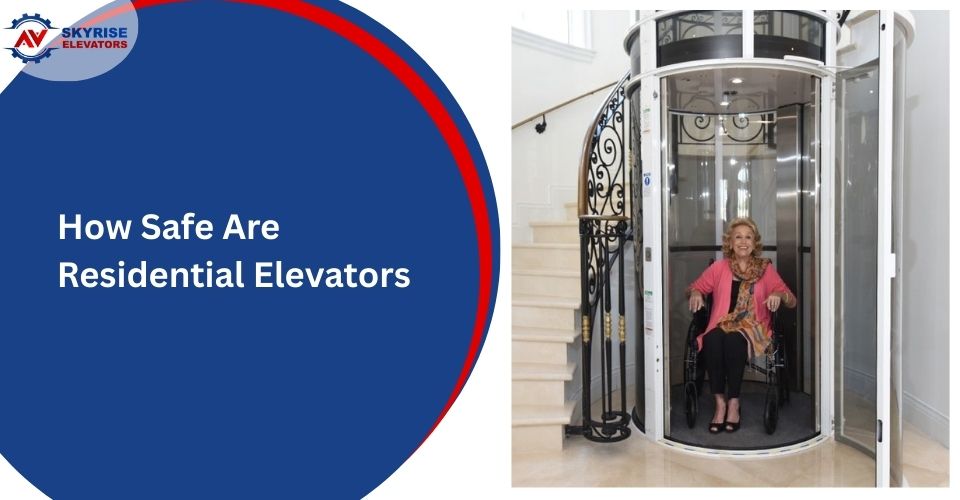
How Safe Are Residential Elevators?
Residential Elevator Safety is one of the main concerns of homeowners who think about installing a home lift. Instead of luxuries, such lifts are now being considered as necessary devices on accessibility particularly to the aging members of the family or those with limited mobility. However, like with any machine, concerns regarding natural safety, maintenance and emergency readiness are natural and justified.
The positive side is that residential elevators of the modern world are constructed in such a manner that they offer many layers of redundancy, and high-tech solutions that ensure their very high safety. When installed correctly, following codes and well maintained, the risks related to the use of home lift are very low, and in many cases, much lower than the risk of using stairs, especially to individuals with limited mobility.
Why Residential Elevator Safety and Home Lift Security Are Non-Negotiable
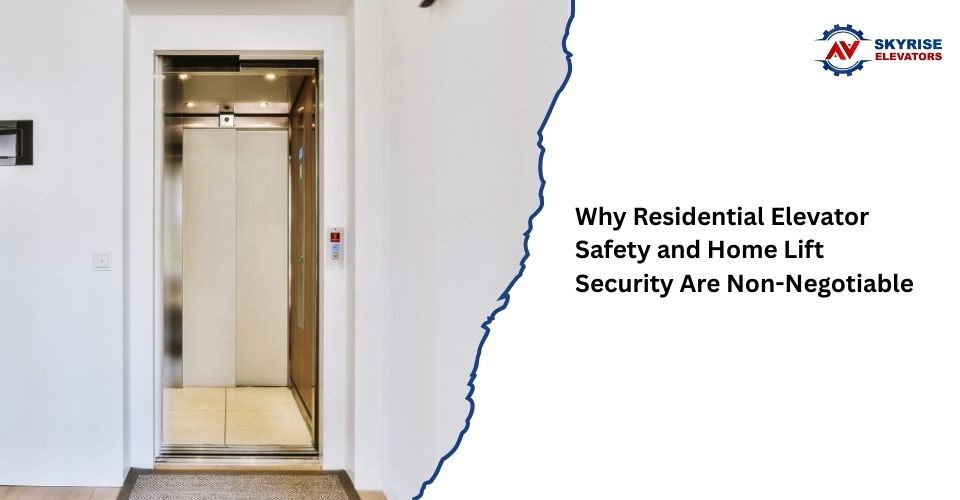
When you invest in a home lift, you invest in being independent and convenient. Nevertheless, first must be safety. Manufacturers comply with high standards in the industry in order to guarantee that all units offer maximum protection. The essence of the design of modern elevators is to ensure that the vehicle does not move unless all gates and doors are safe and to have a failsafe in case of power failure or an emergency.
Here are the key features and mechanisms that ensure a high level of home lift security:
1. Gates
A gate is one of the features that every home elevator must possess to ensure safety. These gates are fitted to the elevator cab implying that they move with the cab wherever it moves. To get into your home elevator you would open the door to the hoistway and then open the gate to get into the elevator cab.
This arrangement is also applied to commercial elevators, except that they do not have a door and a gate, they have two sets of doors, where the first one opens into a hoistway and the second directly into the cab.
You might ask, why not just go into the elevator by one door and walk out by the gate? The fact is that gates are the required element of an elevator door safety. Gates are not there to look pretty. Your elevator will know when a gate is open and closed and will not proceed when someone is half way into the cab. The gate should be absolutely free of any impediment and close before your elevator can operate. This ensures the safety of elevator passengers.
Although gates are basically there not because of aesthetics, but because of safety they can still bring beauty in your home elevator. Gates are of two varieties. Another type is the accredia gate which is a traditional type of gate that can be completed using different materials. The second alternative is a collapsible scissor gate that is available in different finishes of metal.
2. Interlocks
Another significant means of how current home elevators are safe is through interlocks. To get a feel of what interlocks are it is best to consider the dangerous situations that they eliminate. Consider a scenario where one opens a door to his or her elevator on the ground floor and fails to notice that the elevator is already in motion and it is moving downwards on the second floor.
Or, should you open the door, and the elevator is in another landing of your house? You would be opening the door on a vacant elevator shaft in this case.
Both of these are potentially hazardous scenarios, yet you never need to be concerned about these happening when your lifts have interlocks. Interlocks prevent you from opening a door to your elevator which is not at a secure landing in the elevator. That is, your elevator doors will always be locked either when the elevator is moving or at another landing. This prevents you from having to open the door and face a dangerous situation.
How do the locks sense the presence or absence of the elevator? Interlocks consist of two parts, a lock and a keeper bracket that must be linked together to allow the door to open. When they are not connected the door will be closed. These elements are mechanically, electrically or both, connected.
3. Lighting and Indicators
Home elevators should be well lit so that you can tell where you are going at any time. This lighting will be able to prevent falls, slips, and trips which might lead to injuries. Home elevators at Skyrise consist of two low-temperature ceiling lights (LED) that light up whenever the door opens, or the elevator is in motion. We also provide upgrades to our standard lighting system.
Our lifts also have operating panels with floor indicators that are lit. The cab has a panel and one in each landing close to the elevator door. There is a panel in the cab that has an overrun switch and you can press it to switch off your elevator.
4. Backup Power
Without the adequate safety features, a power outage can be hazardous. Home elevators are electric-powered, hence, when electricity goes off, when you are in an elevator, you are likely to be trapped inside the elevator compartment, something no one would wish to experience. Fortunately, this will not be a concern with the contemporary home elevators.
It is due to a significant safety feature which is the backup battery power. Your backup battery power will activate in case of an electrical failure and safely transfer the elevator to the lowest landing. In case a storm causes the loss of power, it is a useful feature because you will usually desire to find refuge in the lowest part of your house.
You will also not need to worry that you will be caught up in the dark in your lift as the power goes off. Emergency lighting is another safety measure that is planned to be used in outages.
5. Handrails
A handrail is one safety feature that does not have to be high-tech. Handrails can be very basic things but they do help in ensuring that the home elevators are safe.
Handrails provide you with something to hold on to in the event that you feel unbalanced and require some form of support to sustain or re-establish your balance. This is particularly useful when dealing with elderly persons or other persons with balance or movement difficulties. Home elevators by Skyrise are fitted with flat wooden handrails in a finish that matches the cab walls or round handrails with a smooth, elegant polish of metal.
6. Emergency Bells and Phones
In case of an emergency like a health crisis, injury or other issue, you will be in your elevator, and you might require a means of calling to get assistance. This is an essential feature that can be offered by emergency bells and in-elevator telephones.
Emergency bells can assist the family or emergency personnel to find you in case of an emergency and you are in or close to your elevator. This alarm should be easily located and operative.
One more optional component that can be added to your home elevator is a telephone. Elevator phones can also be regarded as a safety feature because you have a means of calling out to get assistance in case of an emergency. The phone has an inbuilt speakerphone that is mounted flat, a user-friendly manual dialer and two-way talk. In case your home is provided with an analog telephone line, then it is easy to include a phone in your elevator. These phones are excellent in case you do not carry a cell phone and would want a landline telephone installed in a convenient area in your elevator.
Enhancing Residential Elevator Safety with Regular Maintenance
Although the in-built functions are solid, the professional and routine maintenance is the most important in long-term residential elevator safety. An elevator is a complicated vertical transport system similar to a car, it needs regular check-ups and maintenance so that it can be used as a reliable system. Regular wear and tear inspection, verification that all interlocks and safety circuits are operating properly and that gates and doors are operating smoothly. This is a proactive strategy that not only ensures home lift security but also prolongs the life of the unit and eliminates expensive repairs.
Why Choose Skyrise Elevators?
Skyrise Elevators is a new lift organization, owned and managed by Australians, with the aim of excellence in vertical transportation. They provide skilled and competent service over the Australia region in the case of private, commercial and industrial buildings.
Key Reasons to Choose Skyrise:
- Comprehensive Services:
They do not only do the installation of new elevators and complete replacement but also necessary maintenance and modernisation of old systems.
- Bespoke Solutions:
Skyrise can design and install specific project-specific lift plans, which are a ONE OFF design, and a vast selection of standard designs.
- Specialized Offerings:
They are offering specialized services such as Nbn Lift Phones and multi-stage testing and auditing.
- Core Values:
Their service is characterized by being innovative, reliable, flexible, and honest with the focus on Experience, Execution, and Excellence.
- Dedicated Team:
This consists of a highly experienced and dedicated technical team with a mission of providing safe, affordable, and efficient solutions.
It is the full responsibility of Skyrise to offer the optimal support as it continues to offer its customers the highest level of efficiency in their vertical transport requirement.
Conclusion:
Residential Elevator Safety is a highly designed fact of today with advanced safety measures such as secure interlocks, backup power, and mandatory gates among other features. These aspects would make sure that your home lift is reliable, and it gives you maximum access with as little risk as possible and this is what home lift security is all about. SKYRISE Elevators is one of the best options of homeowners in the Australia region because of innovative designs and quality services that are safe and effective and because of a highly qualified dedicated team and full commitment to continuous support.
Frequently Asked Questions
Q1: Are residential elevators safer than stairs?
A: Yes, for individuals with limited mobility, residential elevators are generally considered safer than navigating stairs, provided they are properly installed and maintained with modern safety features.
Q2: What is the most critical safety concern for homeowners with children?
A: The primary concern is the gap between the elevator’s inner door and the outer landing door; this space must be less than four inches to prevent a child from becoming entrapped, as per safety guidelines.
Q3: What happens if the power goes out while I’m in the elevator?
A: Modern elevators include a battery-operated automatic rescue device (ARD) that will safely lower the car to the nearest floor and open the doors during a power outage.
Q4: How often does a residential elevator need maintenance to remain safe?
A: To ensure continuous safe operation and compliance with safety standards, a professional inspection and maintenance should be performed every 3 to 6 months.
