


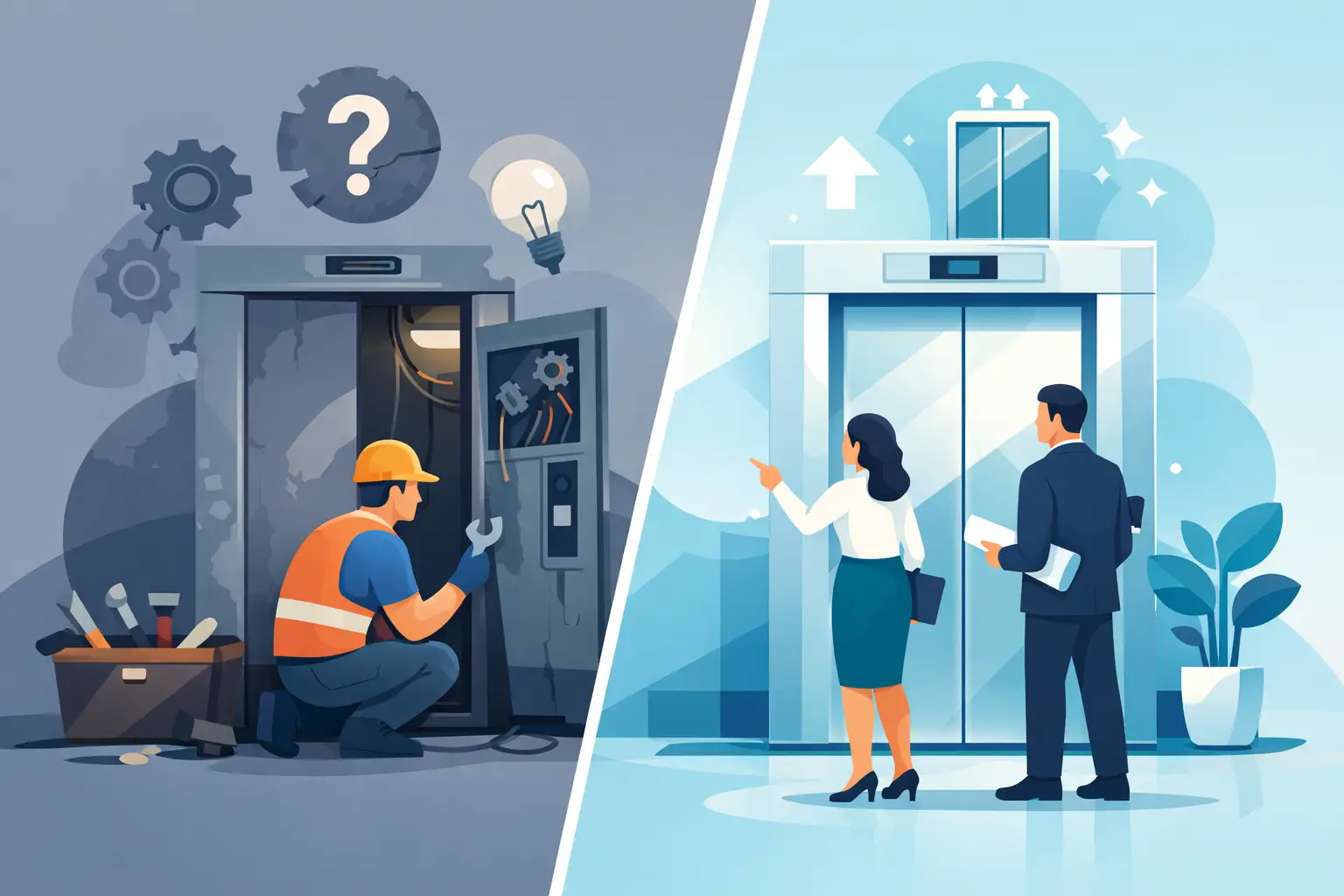
Repair or Replace Old Elevator?
When a lift starts causing repeated call-outs, extended downtime, or tenant complaints, the real question is not whether there is a fault. It is whether to repair or replace old lift equipment before the problem becomes a safety, compliance, or operational issue. For property owners and facility managers, that decision affects budgets, building access, user confidence, and long-term reliability.
When to repair or replace old lift equipment
There is no one-size-fits-all answer. Some ageing lifts can keep performing well with targeted repairs and a disciplined maintenance program. Others have reached the point where each repair only delays a larger and more expensive problem.
The best decision usually comes down to five factors: age, reliability, parts availability, compliance, and the lift’s importance to the building. A low-traffic lift in a small property may justify staged repairs for longer. A passenger lift in a busy commercial, healthcare, retail, or aged care setting often needs a more proactive approach because downtime has a much bigger impact.
If a lift is more than 20 to 25 years old, it deserves closer review. That does not mean automatic replacement, but it does mean the system is likely carrying outdated components, older safety features, and equipment that may be harder to support. In many cases, the issue is not a single part. It is the cumulative wear across the controller, door operator, machine, wiring, landing fixtures, and safety systems.
Signs repair is still the right option
Repair makes sense when the core system remains sound and the faults are isolated rather than recurring across multiple components. If the lift has a solid service history, spare parts are still available, and shutdowns are infrequent, a repair can be the most cost-effective path.
This is often the case where the problem is tied to one identifiable issue, such as a worn door operator component, a faulty landing button, a damaged sensor, or a lift phone fault. In these situations, a quality repair restores operation without forcing the owner into a major capital project before it is necessary.
Repairs can also be the right short-term decision when a building is preparing for refurbishment, redevelopment, or staged capital works. Rather than replacing the lift immediately, the owner may choose to maintain safe operation while planning a broader upgrade later.
That said, repair only works when it genuinely restores dependable service. If the same fault returns, or fixing one issue reveals two more, repair can quickly become false economy.
Repair is usually suitable when:
The lift still meets the building’s operational needs, service interruptions are limited, parts can be sourced in a reasonable timeframe, and the repair cost is proportionate to the value it delivers. A good technician should be able to explain this clearly rather than simply recommending the quickest fix.
Signs it may be time to replace
Replacement becomes the stronger option when the lift is no longer reliable, no longer efficient to maintain, or no longer aligned with the building’s use. In practical terms, this often shows up as rising service costs, increasing downtime, and growing difficulty obtaining parts.
Frequent breakdowns are the clearest warning sign. If building users are routinely reporting entrapments, slow levelling, doors failing to open or close properly, or intermittent controller faults, the lift is no longer supporting the building the way it should. In residential buildings, that becomes a daily frustration. In commercial and public environments, it can affect compliance, accessibility, and tenant satisfaction.
Parts obsolescence is another major trigger. Once manufacturers stop supporting key components, repairs become slower, more expensive, and less predictable. Technicians may need to source refurbished parts or adapt alternatives, which is not ideal for a critical building system.
Safety and compliance also matter. Older lifts may still operate, but that does not mean they reflect current standards or user expectations. Owners are increasingly looking at door protection, emergency communication, levelling accuracy, reliability under load, and accessibility performance. If an old system falls short in several areas, replacement or major modernisation may be the better investment.
Repair or replace old lift: cost is only part of the picture
Many owners start with the immediate cost comparison, which is understandable. Repair is almost always cheaper upfront than full replacement. But the better question is what the building will spend over the next five to ten years, and what level of risk comes with that spend.
A series of smaller repair invoices can look manageable until they begin stacking up. Add technician call-outs, tenant disruption, emergency attendance, delayed parts, and reputational impact, and the true cost of keeping an unreliable lift alive starts to rise.
Replacement requires more capital, but it can reduce unplanned outages, improve energy efficiency, support current safety expectations, and simplify maintenance for years ahead. For many commercial and multi-residential properties, that predictability matters just as much as the hardware itself.
There is also a middle ground. Modernisation can replace major components while keeping parts of the existing lift infrastructure that are still serviceable. Depending on the lift’s condition, that may offer a better balance between cost, downtime, and performance.
The trade-off to consider
If repair buys several more years of stable service, it may be the right decision. If repair only buys a few more months before the next failure, replacement is often the more responsible option.
How building type changes the decision
The same lift issue can lead to very different decisions depending on where the equipment is installed.
In a private home or low-use residential setting, an owner may tolerate a slower lift or minor cosmetic ageing if the system remains safe and reliable. In a strata building, however, reliability becomes a shared issue. Repeated faults quickly turn into resident complaints, access concerns, and pressure on the committee to act.
In healthcare, aged care, education, retail, and commercial buildings, the threshold is even lower. These sites depend on lifts for daily movement of people, goods, trolleys, patients, staff, and visitors. Downtime here is not just inconvenient. It can interrupt operations and create serious access problems.
Industrial settings add another layer. Goods lifts and service lifts often face heavier duty cycles and harsher operating conditions. If an ageing unit is affecting workflow or becoming difficult to service safely, replacement planning should happen early rather than after a major failure.
What a proper assessment should cover
Before deciding to repair or replace old lift systems, the lift should be assessed by a qualified team with experience across repair, modernisation, and full replacement. The value of that assessment is objectivity. A proper review should identify the lift’s current condition, likely fault trends, supportability of parts, safety risks, and realistic service life.
It should also consider the building itself. Has the traffic changed? Are accessibility demands higher than when the lift was installed? Is the property being repositioned or upgraded? These factors can shift the decision even when the lift is still technically operational.
A useful recommendation should not be vague. It should explain what can be repaired now, what will likely need attention next, what risks remain if the lift stays in service, and whether staged modernisation or replacement would deliver better value.
Planning ahead avoids forced decisions
The most expensive lift decisions are often the rushed ones. When an old lift fails beyond practical repair, owners lose the benefit of timing, budgeting, and orderly project planning. They are left reacting to a shutdown instead of managing an upgrade on their terms.
That is why lifecycle planning matters. If a lift is showing its age, even if it is still running, now is the time to review options. You do not need to replace every old system immediately. But you do need a realistic plan for how long it can continue to operate safely and cost-effectively.
For many buildings, the smartest approach is staged: maintain the lift properly, address critical repairs promptly, and plan modernisation or replacement before reliability drops too far. That reduces disruption and gives owners more control over cost and timing.
A dependable lift should support the building, not create uncertainty around safety, access, or service continuity. If your system is starting to raise doubts, a clear technical assessment will usually tell you whether repair is still a sound investment or whether replacement is the better path forward. A practical answer now is far better than an urgent one later.