


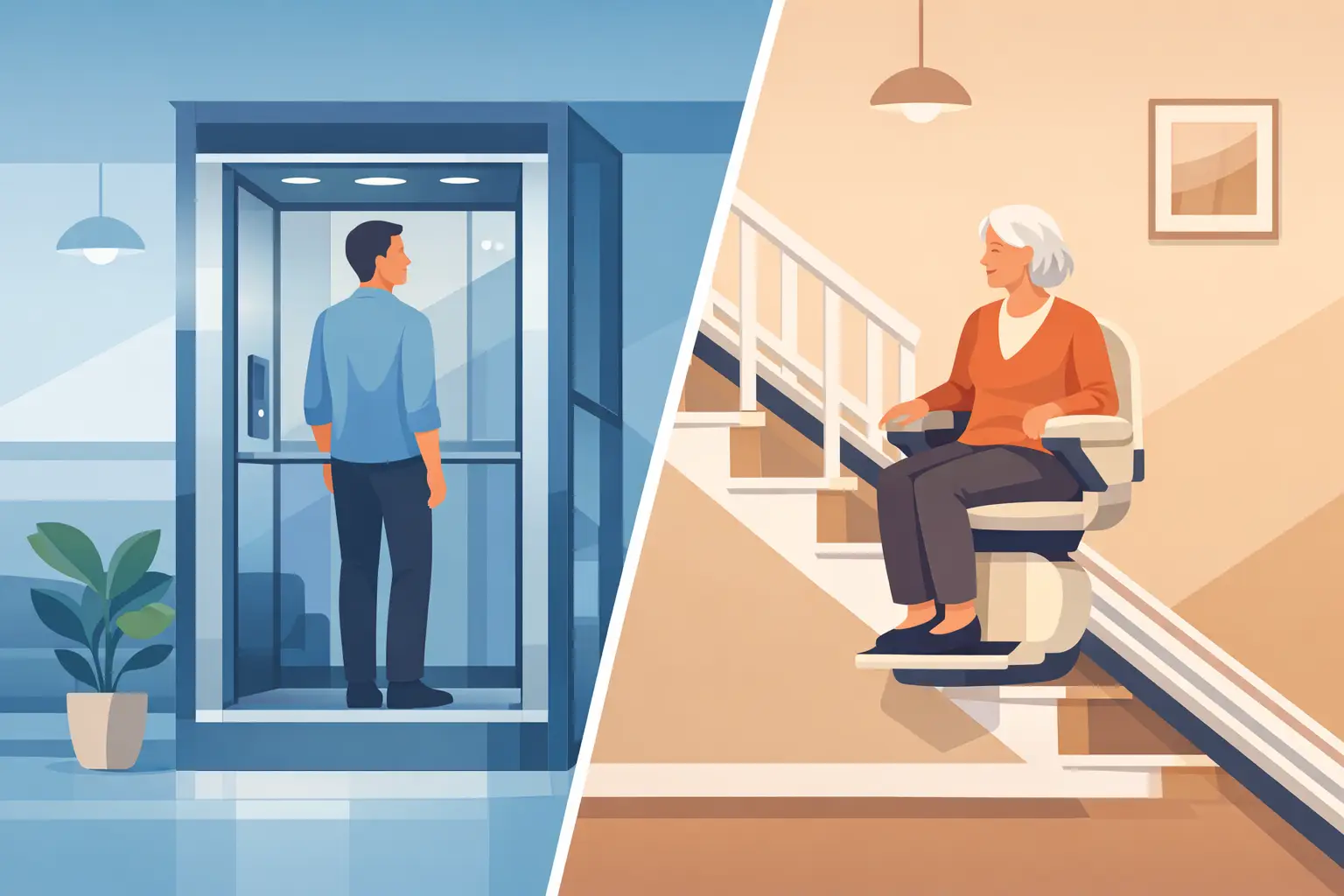
Home Lift vs Stairlift: What Suits You?
A steep staircase can turn a practical family home into a daily frustration. When mobility becomes harder – whether through age, injury or planning ahead – the usual question is home lift vs stairlift, and the right answer depends on more than budget alone.
Both options improve access between levels, but they solve different problems. A stairlift is typically the faster, lower-cost way to help one person use an existing staircase. A home lift is a more complete access solution that can move people, luggage, laundry, prams and, in many cases, wheelchairs between floors with greater comfort and independence. Choosing well means looking at how the property is used now, and how it may need to work in the years ahead.
Home lift vs stairlift: the core difference
The main difference is simple. A stairlift travels along the stairs on a rail, usually carrying one seated passenger. A home lift travels vertically between levels in its own shaft or through-floor arrangement, creating lift access rather than stair access.
That affects almost everything else – the footprint, the look of the installation, user comfort, carrying capacity, and the long-term flexibility of the home. If the goal is to make stairs manageable for one user, a stairlift may be enough. If the goal is to make the whole house more accessible, a home lift is often the stronger long-term investment.
When a stairlift makes sense
A stairlift is often the practical answer when speed and affordability matter most. In many homes, it can be fitted to an existing staircase with less building work than a residential lift. For someone who can still transfer safely onto a seat and does not need wheelchair access, it can restore day-to-day movement between levels without major structural changes.
This can work well in established homes where available space is tight and the owner wants a straightforward mobility upgrade. It is also useful when the need is immediate, such as after surgery or during a period of reduced mobility.
That said, stairlifts come with limits. The user must usually be able to sit, stand and pivot safely. Carrying items while travelling is restricted. Other household members still use the stairs, and depending on stair width and layout, the rail and parked chair can affect circulation. For some homeowners, that is a manageable trade-off. For others, it becomes a daily compromise.
When a home lift is the better fit
A home lift is better suited to households looking for broader accessibility, greater comfort and stronger future value. It offers level-to-level travel without relying on stair use at all, which matters for people with reduced balance, limited strength, walking aids or wheelchair requirements.
It also changes how the home functions. Moving shopping, suitcases, cleaning equipment or even small furniture becomes easier. For multi-generational households, it can support ageing in place without making one family member dependent on assistance each time they need to move between floors.
From a property perspective, a well-planned lift can also feel more integrated. Rather than attaching equipment to the staircase, it creates a dedicated access point designed around the home. In new builds or major renovations, that can make a significant difference to layout quality and long-term usability.
Space and building works
One of the biggest decision points in home lift vs stairlift comparisons is how much space is available and what level of building work is acceptable.
A stairlift usually works with the staircase already in place. Straight stairs are simpler, while curved or multi-landing staircases can require custom rail design. Even when installation is relatively straightforward, the staircase still needs to remain safe and practical for other users.
A home lift generally needs more planning. Depending on the model, it may require a shaft, a through-floor opening, or dedicated floor space across levels. That makes early design coordination especially valuable in new homes and renovations. In an existing property, feasibility depends on structure, available footprint and how well the lift can be integrated without disrupting essential rooms or circulation.
More building work does not automatically mean the lift is the wrong option. It simply means the decision should be made with a clear view of access goals, property constraints and the value of a solution that serves the household for the long term.
Cost now versus value over time
A stairlift will usually have the lower upfront cost. For many households, that is the deciding factor, particularly when the need is immediate or expected to be temporary.
A home lift generally involves a higher initial investment because the system itself is more complex and installation may include structural works, electrical requirements and finishing works. However, upfront cost is only one part of the picture.
If mobility needs are likely to increase, installing a stairlift first and replacing it later with a home lift can mean paying twice. If the property is intended as a long-term residence, or if accessibility is a core requirement rather than a short-term convenience, a lift may offer better value over time.
There is also the question of usability. A lower-cost option that only partly solves the problem can become expensive in practical terms if it leads to ongoing assistance needs, layout workarounds or another upgrade a few years later.
Comfort, safety and independence
Comfort matters more than many people expect. A stairlift can be very effective, but some users feel uneasy travelling along an incline, particularly on narrow or open stairs. Getting on and off at the top landing can also be a concern if balance is limited.
A home lift provides a different experience. It offers enclosed or semi-enclosed vertical travel, level entry and exit, and a more stable ride. For users with greater mobility challenges, that can improve both confidence and safety.
Independence is another major factor. A person who cannot manage transfers easily may not be well served by a stairlift, even if one fits the staircase. In those cases, a lift is often the more appropriate accessibility solution because it reduces physical effort and reliance on others.
Aesthetics and property use
Some homeowners are comfortable treating accessibility equipment as purely functional. Others want a solution that feels integrated with the property and supports presentation as well as access.
A stairlift is visible by nature. Even when folded away, the rail remains part of the staircase. In some homes, that is not an issue. In others, especially higher-end residences or architecturally considered interiors, it may not be the preferred outcome.
A home lift can often be designed to sit more naturally within the building. Finishes, door configurations and placement can be selected to work with the property rather than around it. For builders and developers, this matters because access features that are planned properly tend to perform better both functionally and visually.
Maintenance and long-term support
Whichever option you choose, reliability matters. Access equipment is not something owners want to second-guess, especially where an elderly resident or mobility-impaired user relies on it every day.
Stairlifts and home lifts both require appropriate servicing, but the support model should be part of the buying decision, not an afterthought. Installation quality, response times, technician availability and ongoing maintenance all affect long-term performance.
That is why many property owners prefer working with a provider that can handle not just installation, but also maintenance, repairs, modernisation and eventual replacement if needs change. Skyrise Elevators takes that service-led approach, helping clients choose solutions that remain dependable well after handover.
How to decide between a home lift and a stairlift
The best choice usually comes down to four questions. Who needs to use it? How long will it be needed? What level of accessibility is required? And how much change can the property accommodate?
If the user can transfer independently, the staircase is suitable, and the goal is a faster, lower-cost mobility aid, a stairlift may be the right fit. If the user needs easier access with fewer physical demands, wheelchair compatibility, better comfort, or a solution that supports the whole household into the future, a home lift is often the stronger option.
There is no one-size-fits-all answer. The right recommendation depends on the home, the user and the level of support expected over time. A proper site assessment can quickly clarify what is feasible and what will deliver the safest, most practical result.
The best mobility solution is the one that keeps the property working well for everyday life – not just this year, but for the years ahead.