


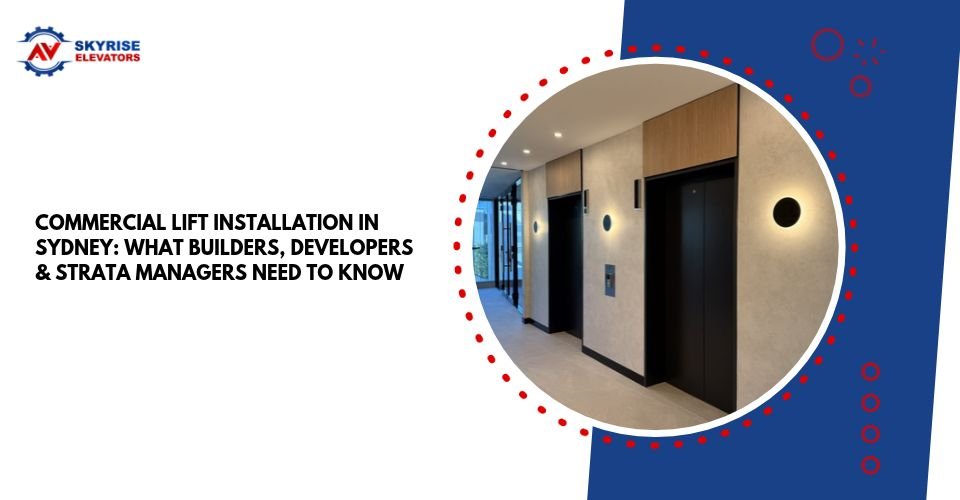
Commercial Lift Installation in Sydney: What Builders, Developers & Strata Managers Need to Know
A commercial lift is one of the biggest single investments in any building project, and it’s the one piece of equipment tenants, visitors and auditors will all interact with daily. Get it right and it quietly serves the building for decades. Get it wrong and it becomes the defect list that never closes. Yet lift decisions are often left until the design is locked, when the options that matter have disappeared.
That’s why experienced builders, developers and strata managers treat commercial lift installation in Sydney as a project within a project, coordinated from day one rather than ordered off a shelf. Here’s what you need to know before the shaft is even poured.
What Commercial Lift Installation in Sydney Really Involves
Many people picture installation as the week the lift arrives. In reality, it’s a staged process that runs across your entire program:
● Design confirmation: shop drawings lock shaft dimensions, door sizes, power supply and finishes with the whole project team
● Site preparation: the shaft is built, waterproofed and dimensionally checked before equipment arrives on site
● Sequential installation: guide rails, entrances, machinery, cab components, wiring and control systems go in, in order
● Testing and commissioning: safety testing, tuning and compliance checks before handover
Each stage depends on the one before it, which is why late changes to shafts or power hurt so much.
Shaft, Pit and Power: Details Builders Can’t Leave Late
The most expensive words on any lift project are “we assumed that was handled”. Shaft size, pit depth, overhead clearance and machine space must be confirmed early, because concrete is unforgiving once poured.
● Confirm pit depth and headroom against the selected model, not a generic brochure
● Provision dedicated power supply and clear access paths for equipment delivery
● Hand over a shaft that is dimensionally correct, waterproof and secure
● Lock landing configurations and door widths before shop drawings are finalised
Treat any of these as an afterthought and you invite variations, redesign fees and a program that slips week by week.
Compliance and Australian Standards
Commercial lifts in Australia must comply with the AS 1735 series, along with accessibility requirements, fire and emergency interfaces and electrical safety rules. Compliance isn’t a final box to tick; it needs to be designed in from day one, because rectifying a non-compliant shaft or control interface afterwards is painfully expensive.
Accessibility deserves special attention in commercial work. Door widths, car dimensions, landing levels and audible or visual signals all affect how comfortably people with mobility needs use the building, and they interact directly with the builder’s finished floor levels. Getting these coordinated early avoids expensive rectification late in the piece.
Keep the paperwork in mind too. Design registration, installation inspection and plant registration all form part of the compliance record that follows the asset for life, and lands squarely in the owners corporation’s hands at handover.
Timelines: Why Early Coordination Protects Your Program
The most common cause of lift-related delays isn’t equipment supply. It’s misalignment between the builder, the consultant and the lift contractor on dates, responsibilities and site readiness. When those three parties aren’t working from the same schedule, the lift becomes the trade that holds up everything else.
Bring your lift partner in during design, not after structural drawings are done. A specialist in commercial lift installation in Sydney can flag shaft conflicts, power limitations and access constraints while they’re still cheap to fix, and sequence deliveries around your crane and hoisting windows.
Replacement and modernisation projects carry their own timing traps: existing structures, tenant access, noise restrictions and temporary shutdowns all need planning that new builds never face. Allow more lead time than you think you need, and communicate early with the people who use the lift every day.
After Handover: What Strata Managers Are Responsible For
Once the builder leaves, the owners corporation inherits the asset, along with a specific set of legal duties:
● Keep registration and maintenance records: design registration, safe-to-operate and plant registration certificates, plus current adequate-maintenance documentation
● Hold appropriate public liability cover, commonly $10 million for commercial buildings
● Ensure emergency lift phones work on the NBN; an inoperable phone can force a lift shutdown
● Carry out risk assessments and act on them to protect owners, tenants and visitors
Installation quality drives all of it. A well-installed, well-documented lift means fewer compliance headaches and lower lifecycle costs for the scheme.
Questions Worth Asking Before You Sign
The right contractor welcomes hard questions. Before you award the contract, ask:
● Which Australian Standards apply to this installation, and how will compliance be evidenced?
● What parts support and service response do you guarantee after handover?
● How will deliveries and installation sequence around our crane and hoisting schedule?
● What documentation will the owners corporation receive at handover?
● Can you show comparable commercial projects completed in Sydney?
Cost Traps: Why the Cheapest Quote Can Cost More
Choosing a lift on upfront price alone is a classic false economy. A lower sticker price can hide weaker parts support, awkward service access and reliability issues that inflate maintenance costs for years.
Finishes deserve the same scrutiny. Premium materials look wonderful on handover day, but in high-traffic commercial environments, durable, easy-to-maintain finishes are usually the smarter investment. Judge every quote on lifecycle value: reliability, service response and parts availability, not just the number at the bottom.
Why Choose Skyrise Elevators?
Because Sydney projects need a lift partner who stays long after handover. Skyrise Elevators installs, maintains, repairs and modernises commercial and residential lifts, escalators and freight lifts across Sydney, with one accountable team from first shop drawing to ongoing service calls.
● New commercial lift installations coordinated around your build program
● Planned maintenance and rapid repairs that protect uptime
● Modernisation that extends asset life without full replacement
● NBN-compatible emergency lift phone upgrades for compliance
Every project also benefits from transparent communication and support that answers quickly, because minimum downtime is an operational requirement, not a luxury.
Final Thoughts
A commercial lift rewards early planning and punishes assumptions. Confirm the shaft details, align the timelines, design compliance in from the start, and weigh lifecycle value over sticker price. Above all, choose a partner who treats commercial lift installation in Sydney as a long-term relationship rather than a one-off sale. Do that, and your lift will keep the whole building moving for decades to come.
Ready to plan a commercial lift that performs from day one? Call Skyrise Elevators today for expert advice and a free, no-obligation quote.
Visit skyriseelevators.com.au and let Sydney’s lift specialists keep your project, and your building, moving.