


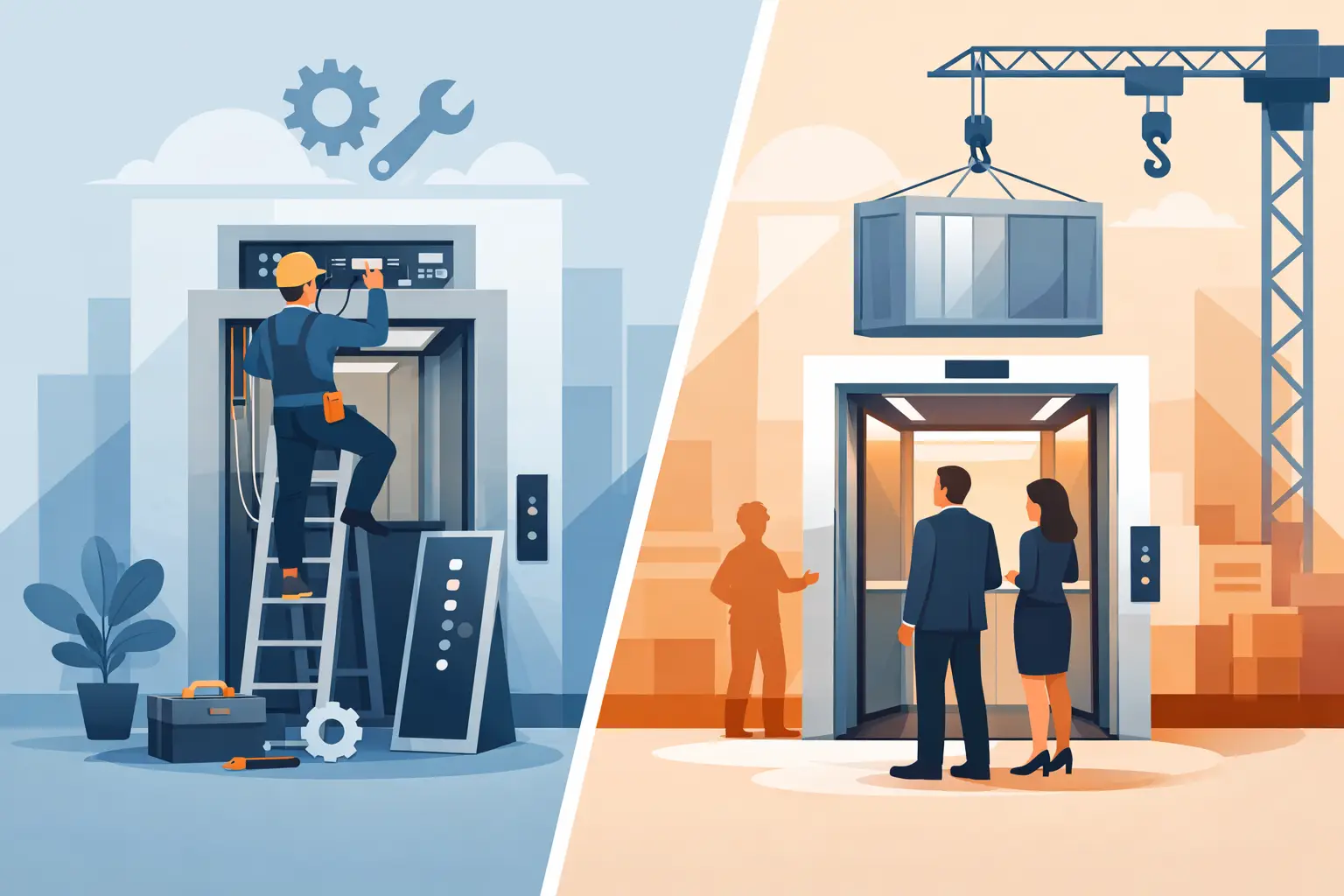
Lift Modernisation Versus Replacement
A lift that still runs is not always a lift that still makes commercial sense. For building owners and facility managers, lift modernisation versus replacement usually becomes a live issue when breakdowns increase, parts get harder to source, tenants start complaining, or compliance concerns begin to surface.
The right answer depends on the age of the equipment, the condition of key components, the building’s operational demands, and how long you plan to hold the asset. Some lifts respond well to staged upgrades. Others have reached the point where a full replacement is the safer and more cost-effective path.
What lift modernisation versus replacement really means
Modernisation means upgrading selected parts of an existing lift system while keeping the core installation in place. That can include the controller, drive, door operators, landing fixtures, car interiors, safety systems, communication equipment, and other ageing components that affect reliability and performance.
Replacement means removing the existing lift system and installing a new one. Depending on the site, that may involve a full replacement within the current shaft and machine space, or a broader redesign to suit updated building use, accessibility needs, or capacity requirements.
This is not just a technical decision. It is an asset planning decision that affects tenant experience, maintenance costs, compliance exposure, energy use, downtime, and the long-term value of the property.
When modernisation is the better option
Modernisation is often the practical choice when the lift structure is fundamentally sound but the performance of individual systems is falling behind. In many residential, commercial, education, and mixed-use buildings, the guide rails, car frame, and shaft arrangement can remain serviceable for years after controls and door equipment have become outdated.
If your main issues are intermittent faults, slow levelling, noisy doors, poor ride quality, or obsolete electronic components, modernisation can restore reliability without the disruption of a full replacement. It can also be staged to suit budget cycles, which matters for strata committees, aged care operators, schools, and facilities teams balancing multiple capital works priorities.
A well-planned modernisation can improve safety, reduce call-backs, lower energy consumption, and make parts sourcing easier. It may also refresh the car appearance and passenger interface, which helps in tenant-facing environments where presentation matters.
That said, modernisation has limits. If too many major systems are already at end of life, staged upgrades can start to look like repeated spending on a platform that no longer suits the building.
Signs your lift may suit modernisation
A lift is often a good candidate for modernisation when the core equipment is structurally sound, traffic demand has not materially changed, and the existing shaft arrangement still works for the building. You may also be seeing increasing service issues linked to ageing electrical or door components rather than major mechanical failure.
In these cases, upgrading the high-wear or obsolete elements can significantly extend service life. For many properties, that delivers a better return than rushing into a full replacement.
When replacement makes more sense
Replacement becomes the stronger option when the existing lift can no longer meet the building’s practical or regulatory needs. That may happen because the unit is too old, too unreliable, too small, too slow, or too difficult to maintain economically.
If the lift has chronic downtime, unavailable parts, outdated safety features, and a poor maintenance history, modernisation may only postpone a bigger problem. The same applies where building use has changed. A lift designed for an older office building may not cope well with current traffic loads, accessibility expectations, or service requirements.
For industrial and service environments, replacement can also be the right call when the lift no longer matches operational demand. A goods lift handling heavier loads or more frequent use than originally intended will often cost more to patch over time than to replace properly.
Replacement also gives you a clean platform for long-term planning. New systems can be selected around current standards, energy efficiency goals, usage patterns, and maintenance strategy, rather than trying to adapt ageing equipment to modern expectations.
Signs replacement may be the better investment
You should look closely at replacement if major components are failing across the system rather than in isolation. Frequent shutdowns, poor spare parts availability, repeated passenger complaints, non-compliant features, and rising maintenance spend are all warning signs.
The age of the lift matters, but age alone is not the deciding factor. A well-maintained older lift can remain serviceable, while a younger unit with poor support history can become a liability much sooner.
Cost is important, but not on its own
Many owners start with capital cost, which is understandable. Modernisation usually has a lower upfront cost than full replacement, especially when the shaft and core mechanical structure can stay in place. It can also reduce immediate disruption and shorten approval pathways in some buildings.
But the lower initial figure does not always equal lower whole-of-life cost. If a modernised lift still relies on ageing legacy components, maintenance costs can remain elevated. You may get an improvement, but not a full reset.
Replacement has a higher entry cost, yet it can reduce unplanned breakdowns, improve efficiency, and provide stronger long-term supportability. For buildings with high lift dependence, fewer outages and more predictable maintenance can offset the larger initial spend over time.
This is where a condition assessment matters. Good advice is not about pushing the bigger project. It is about comparing realistic lifecycle outcomes based on the actual state of the equipment.
Downtime, tenants and building operations
The best technical answer can still be the wrong operational answer if timing is ignored. A residential tower with a single lift, a medical facility with essential movement needs, or a retail site with constant public traffic will have a lower tolerance for extended outages.
Modernisation can sometimes be staged to reduce disruption, particularly where one lift in a bank can be taken offline at a time. Replacement may require a longer shutdown, although in some cases it delivers a faster route to stable performance than repeated disruptive repairs on failing equipment.
Building managers should also consider the hidden cost of unreliability. A lift that frequently fails causes more than inconvenience. It affects accessibility, tenant confidence, contractor scheduling, and staff time. In aged care, healthcare and residential settings, the operational consequences can be significant.
Safety and compliance cannot be treated as optional
Safety is often what forces the issue. Older lifts may continue to operate while lacking features expected in more current installations, or while carrying increasing risk due to worn components and outdated controls.
Modernisation can address many safety-related concerns if the upgrade scope is properly defined. New controllers, door systems, levelling improvements, emergency communications, and other safety enhancements can materially improve performance and reduce risk.
However, if the lift’s design limitations make it difficult to achieve the required outcome, replacement may be the only sensible path. This is especially true where compliance upgrades would be extensive, fragmented, or poor value when compared with installing a new system.
How to assess lift modernisation versus replacement properly
The decision should be based on evidence, not assumptions. Start with a technical review of the lift’s age, service history, breakdown trends, component condition, parts availability, safety status, and traffic suitability. Then look at the building context. Is the asset likely to be held long term? Has usage changed? Are there tenant expectations or accessibility needs that the current lift does not meet?
From there, compare two realistic paths: the scope and expected life extension of a modernisation, and the cost and operational benefit of a full replacement. A reliable provider should be able to explain the trade-offs clearly, including what each option will and will not solve.
For many properties, the answer is not absolute. A staged modernisation may be the right interim move for a building scheduled for broader redevelopment later. In other cases, delaying replacement only increases maintenance spend and operational risk.
At Skyrise Elevators, this is approached as a lifecycle decision, not just a repair quote. The aim is to keep people moving safely, minimise downtime, and match the solution to the building rather than forcing the building to fit the solution.
The better choice is the one that fits your building
Lift modernisation versus replacement is rarely a simple yes-or-no question. The better decision comes from understanding what the lift can still do well, where the risks are increasing, and what your building will need over the next ten to fifteen years.
If your lift has a solid foundation and targeted upgrades will restore dependable performance, modernisation can be a smart investment. If the system is becoming unreliable, difficult to support, or no longer fit for purpose, replacement may protect your budget and your building better in the long run.
A clear site assessment usually brings the answer into focus. Once you know the condition of the equipment and the real cost of keeping it, the next step tends to be much easier.