


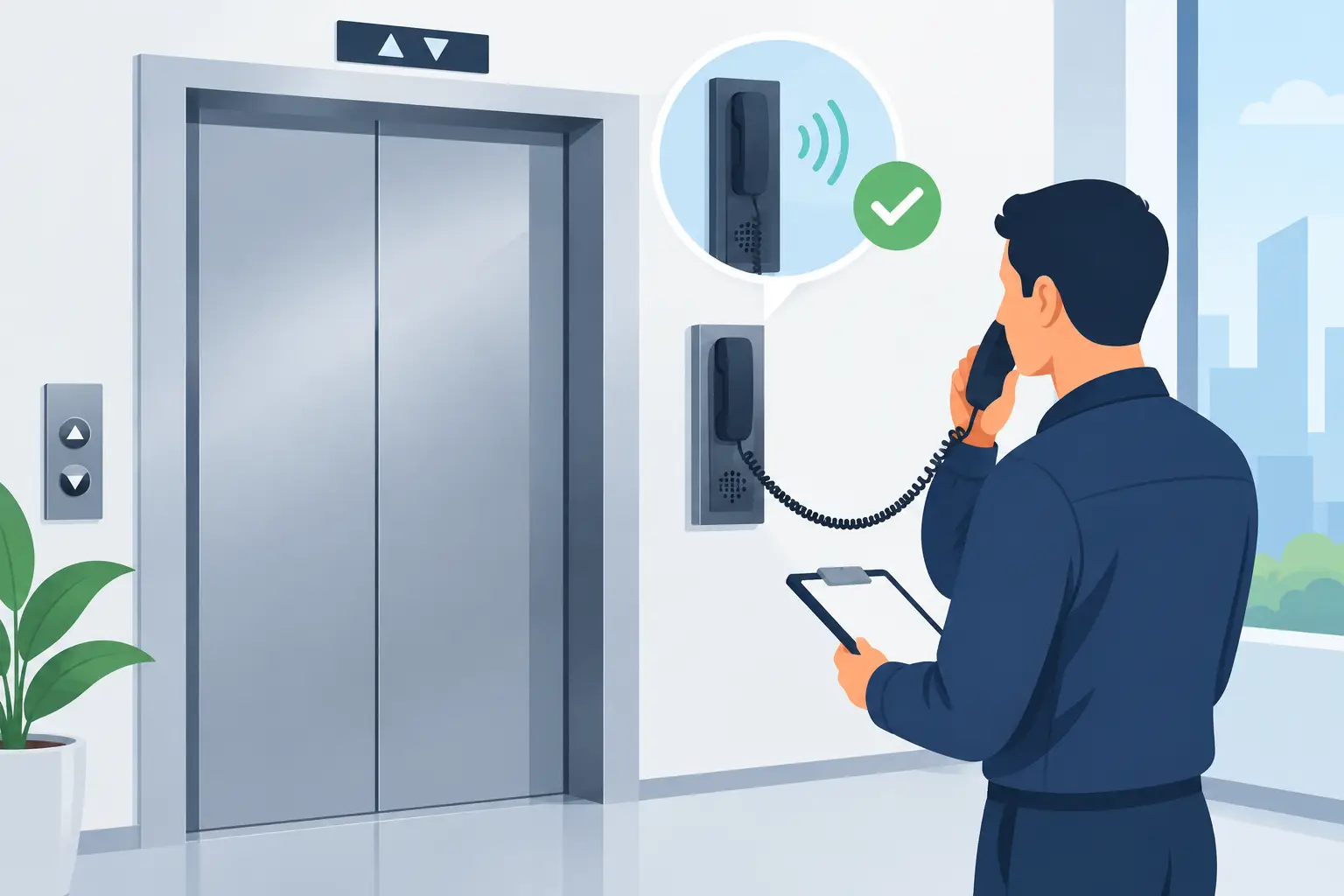
How to Test Lift Phones for Reliable Help
A passenger presses the alarm button because the lift has stopped between floors. At that moment, the emergency phone must do more than have power – it must connect to a person who can identify the lift, speak clearly and organise assistance. That is why building teams need to test lift phones as part of a planned maintenance routine, not after an incident exposes a fault.
For facility managers, owners corporations and building owners, a working lift phone is a critical safety measure. It supports passengers when they are distressed, helps responders locate the correct lift car, and reduces uncertainty during an entrapment. Regular testing also provides useful evidence that emergency communications have been checked and any faults were acted on promptly.
Why test lift phones before an emergency occurs
A lift can operate normally for weeks while its emergency communication system has a hidden issue. A failed battery, damaged handset cord, poor mobile signal, disconnected line, outdated contact number or programming error may only become obvious when someone needs help. By then, the consequences can be serious for the passenger and disruptive for the building.
Testing verifies the full communication path, not simply whether a light appears on the phone panel. The alarm button needs to trigger a call, the call needs to reach the designated contact point, and the receiving person needs enough information to respond correctly. If the system identifies the building or lift automatically, that information should also be accurate.
This matters especially in buildings with several lift cars, multiple towers or separate loading and passenger lifts. A call that reaches a security desk but does not identify the lift location can delay a response. Clear identification is one of the simplest ways to support faster assistance.
Lift phone checks also protect building operations. An unplanned lift shutdown, emergency callout or tenant complaint can quickly become expensive. Finding a weak battery or poor network connection during routine maintenance is usually far less disruptive than discovering it during a passenger entrapment.
What a lift phone test should confirm
A useful test is controlled, documented and completed by people who understand the building’s emergency response process. The exact method depends on the lift phone system, monitoring arrangement and site requirements, but it should confirm that the alarm call works from inside the car.
The person conducting the test should press the emergency alarm button and confirm that the call is answered at the intended destination. This may be a 24-hour monitoring centre, building concierge, security team, facilities contact or approved lift service provider. The person receiving the call should be able to hear the passenger position clearly, and the person in the lift should hear the response without excessive interference or delay.
The test should also check that the correct lift and address details are available to the responder. For sites using automated diallers, this includes verifying the programmed identification message. Where a lift uses a mobile network gateway, signal strength and call reliability deserve particular attention. Mobile network changes, building alterations and equipment ageing can all affect performance.
Other practical checks include the condition of the handset, speaker, microphone, alarm button and signage. If the system relies on backup power, that backup arrangement must be maintained in line with the equipment requirements. A phone that works only while normal building power is available may not provide the assurance required during a broader power event.
A practical process for testing lift phones
Before beginning, notify the people who may receive the emergency call. This prevents a test from being treated as a genuine entrapment and ensures the call handler is ready to verify the information. If the lift needs to be temporarily taken out of service, use clear signage and follow the building’s safety procedures.
For most buildings, the test process should cover these five points:
- Confirm the lift car is safe to enter and the test will not create a risk for passengers or site operations.
- Activate the emergency alarm phone from inside the lift car and wait for the connection.
- Verify two-way audio quality, the receiving contact, the lift identification and the building address.
- Record the date, lift number, test outcome, call recipient and any faults or unusual delay.
- Arrange corrective work promptly if the phone does not connect, audio is unclear or the call reaches the wrong destination.
Do not assume that a quick call from a mobile to the lift number is an adequate test. That may show that a number exists, but it does not prove the in-car alarm button, autodial function, speaker and microphone will work as intended. The emergency call should be initiated from the lift equipment passengers will use.
It is also worth checking your escalation arrangements. If the primary number is unanswered, what happens next? Some systems are programmed to call more than one number in sequence. Others connect directly to a monitoring centre. The right arrangement depends on building hours, occupancy, security staffing and the capacity of the nominated contact to respond. A small residential building may have different needs from a hospital, shopping centre or industrial facility operating around the clock.
Keep a clear record of every test
A maintenance record turns a routine check into a manageable safety process. Record the lift identifier, date and time, the person completing the check, who received the call and whether the audio and identification details were satisfactory. Include the action taken for any fault, as well as the completion date for repairs.
These records help facility managers track repeated faults and demonstrate that concerns have been addressed. They are also valuable when a building changes phone providers, monitoring contacts or lift maintenance contractors. Emergency contact details can become outdated surprisingly quickly after staff changes or site handovers.
Common lift phone faults and what they mean
No connection is often linked to a disconnected service, failed communicator, flat backup battery, power issue or mobile network problem. Intermittent calls can point to weak coverage, ageing equipment or a loose connection. Poor audio may be caused by a damaged microphone, speaker fault, handset issue or water and dust ingress around the car operating panel.
Incorrect location details are just as significant as a failed call. If the monitoring contact receives an old building name, a previous address or an unclear lift reference, the system needs reprogramming. For large sites, make sure lift labels used by the phone system match the labels known to building staff and emergency responders.
Do not leave a phone fault until the next scheduled visit if the lift remains in service. The appropriate response depends on the fault, the building risk profile and applicable requirements, but passenger safety must lead the decision. An approved lift technician can assess the communication equipment, identify the cause and advise whether the lift can remain operational while repairs are arranged.
Set a testing schedule that matches your building
There is no one-size-fits-all testing interval for every property. Your maintenance agreement, lift equipment, monitoring service, building use and applicable Australian requirements should guide the schedule. High-traffic sites, aged care facilities, healthcare settings, education campuses and buildings with limited on-site staff may need closer attention than a lightly used private residential lift.
The key is consistency. Include lift phone testing in planned maintenance discussions, review records after each service visit and update call contacts whenever operational responsibilities change. If your building has recently been refurbished, changed telecommunications providers or experienced network reliability issues, arrange an additional check rather than waiting for the normal cycle.
Skyrise Elevators can assess lift phone performance as part of a structured maintenance approach, including fault finding, emergency communication checks and upgrades where ageing equipment no longer suits the site.
A lift phone is a small component with a large responsibility. Give it the same attention you would give the lift doors, alarm system and levelling performance, so a passenger who needs assistance can reach the right person without delay.