


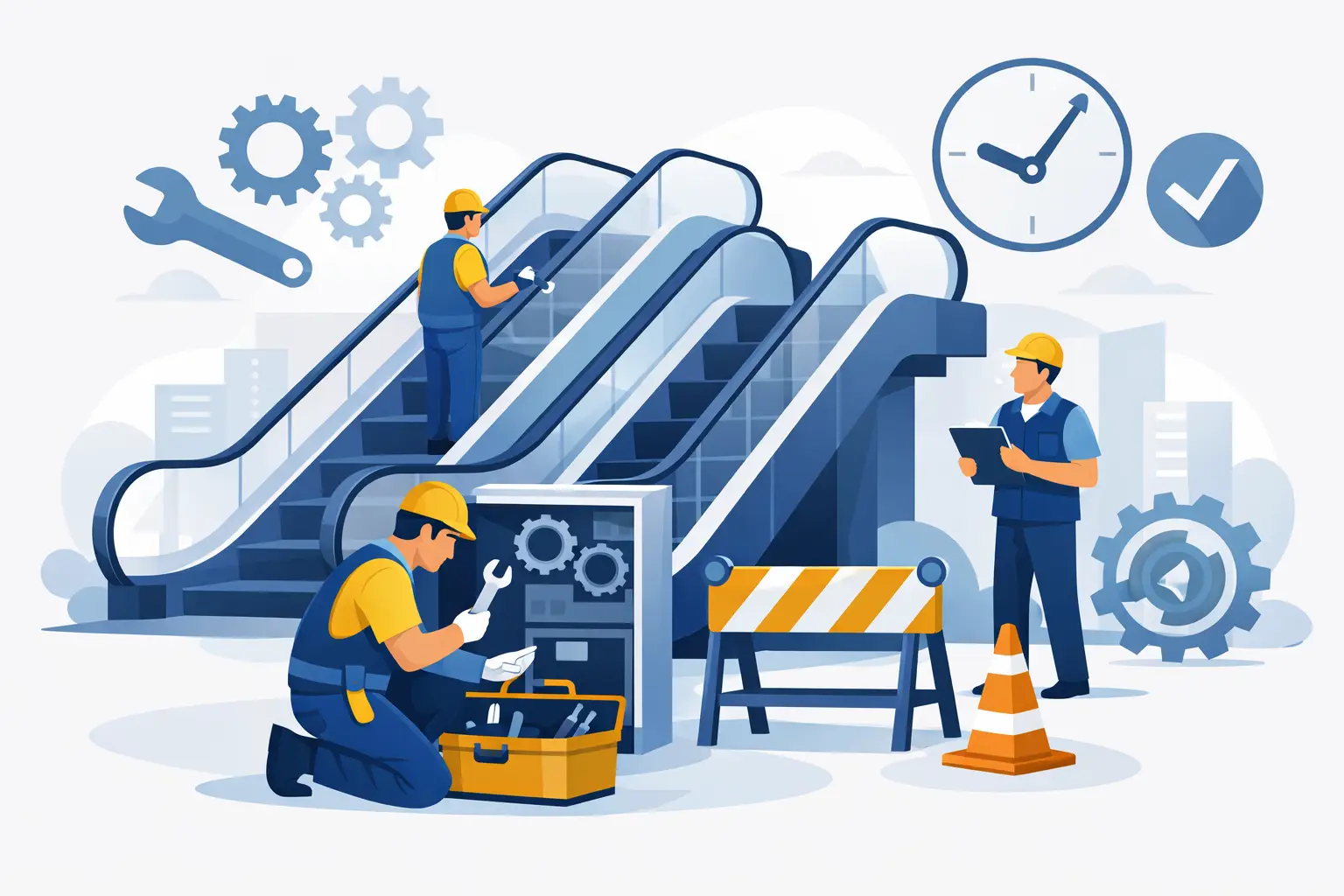
Escalator Maintenance Services That Reduce Downtime
When an escalator stops, the problem is rarely limited to the equipment itself. In a shopping centre, it disrupts customer flow. In a hospital or transport hub, it adds pressure to already busy access routes. In commercial buildings, it reflects poorly on site operations. That is why escalator maintenance services matter – not as a box-ticking exercise, but as an essential part of keeping a building safe, efficient and dependable.
For property owners, facility managers and developers, the real value of maintenance is predictable performance. A well-maintained escalator is less likely to suffer avoidable faults, less likely to create safety concerns, and more likely to deliver reliable day-to-day service over the long term. It also gives you a clearer view of the asset’s condition, so you can plan repairs and upgrades before small issues become major interruptions.
What escalator maintenance services should cover
Effective escalator maintenance goes beyond occasional inspections. It should be structured, consistent and tailored to the age, usage and environment of the equipment. A retail escalator running long hours in a high-traffic setting will not have the same service profile as one in a low-volume office building. The maintenance approach needs to reflect that.
At a practical level, servicing usually includes checking mechanical and electrical components, inspecting handrails, step chains, tracks, comb plates, balustrades, safety devices and control systems, and testing operation under normal conditions. Cleaning also plays a major role. Dirt, debris and build-up in key areas can accelerate wear, interfere with sensors and increase the risk of breakdowns.
Good maintenance is not only about finding faults. It is also about identifying wear patterns, tracking component condition and making timely recommendations. That level of oversight is what helps reduce emergency call-outs and supports better lifecycle planning.
Why scheduled escalator maintenance services are worth it
Reactive repairs usually cost more than planned servicing. They also create more disruption. If an escalator is taken out of service unexpectedly, the impact can spread quickly through a building, especially where foot traffic depends on smooth circulation between levels.
Scheduled escalator maintenance services help address this by creating a regular service rhythm. Technicians can inspect critical parts, adjust components, lubricate where required, test safety systems and note early warning signs before performance drops. In many cases, this prevents faults that would otherwise result in shutdowns.
There is also a compliance and duty-of-care aspect. Building owners and managers are responsible for maintaining safe access systems. Regular maintenance supports that responsibility by helping ensure the equipment is operating as intended and that any defects are addressed promptly. It is not just about keeping people moving. It is about reducing operational risk.
The cost of delayed servicing
It can be tempting to stretch maintenance intervals, especially if an escalator appears to be running normally. That decision often creates false savings. Escalators are complex systems with moving parts under constant load. Wear does not always show itself clearly until the equipment is already close to failure.
Missed servicing can lead to faster deterioration of chains, rollers, handrail drives and other essential components. It can also cause small alignment issues to become larger mechanical problems. Once that happens, the repair scope is broader, parts replacement becomes more likely, and downtime is usually longer.
For sites with high public visibility, the reputational cost should not be overlooked either. Repeated outages can affect tenant satisfaction, customer experience and confidence in site management. In healthcare, education and aged care settings, reliability carries even more weight because accessibility and circulation are critical to daily operations.
What a strong maintenance provider looks for
A capable maintenance provider does more than attend site and run through a checklist. The best service partners take a preventative approach. They look at how the escalator is performing over time, where wear is occurring, whether usage patterns have changed, and what interventions will deliver the best result with the least disruption.
That includes assessing the condition of safety mechanisms, verifying correct operation of emergency stop functions, checking step demarcation and comb impact devices, and reviewing any unusual noise, vibration or movement. It also means paying attention to surrounding conditions. Dust, moisture, poor cleaning practices and heavy usage can all influence servicing needs.
Communication matters just as much as technical skill. Facility teams need clear reporting, practical recommendations and realistic guidance on urgency, cost and timing. If a component is wearing but still serviceable, that should be explained. If a repair cannot reasonably be delayed, that should be stated plainly. Maintenance works best when decision-makers have accurate information and enough lead time to act.
Escalator maintenance services for different building types
Not every building uses escalators in the same way, so maintenance planning should reflect site conditions rather than follow a generic schedule.
In retail centres, escalators often operate for extended hours with constant passenger movement. These sites usually benefit from frequent inspections, close monitoring of handrails and steps, and careful housekeeping around entry points where debris can accumulate.
In commercial buildings, traffic may be more concentrated around peak periods such as morning arrivals, lunch and end of day. Here, maintenance may need to focus on preserving reliable performance during predictable demand windows while scheduling works outside business hours where possible.
In airports, stations, hospitals and other public-access environments, uptime expectations are high and disruption can have immediate operational consequences. These locations often require a more intensive maintenance strategy, faster response capability and careful coordination with site management.
Industrial and back-of-house settings bring different challenges again. Dust, heavier contamination and tougher operating conditions can place added strain on certain components, which means cleaning and inspection routines become even more important.
Maintenance, repairs and modernisation are connected
There comes a point when regular servicing alone is not enough to deliver the reliability a site needs. An older escalator may still be operational, but if faults are becoming more frequent, parts are harder to source, or energy efficiency is poor, a broader review is often justified.
This is where maintenance history becomes valuable. A detailed service record can show whether the issue is isolated or part of a larger pattern. It can also help determine whether targeted repairs, component upgrades or full modernisation will offer the best return.
There is no single rule here. Some escalators respond well to strategic replacement of worn parts and updated controls. Others may be nearing the point where ongoing repair costs no longer make practical sense. A provider with experience across maintenance, repairs and upgrades can guide that decision with more confidence because they are looking at the full lifecycle, not only the next call-out.
Choosing the right service partner
If you are comparing providers, the key question is not simply who can service the equipment. It is who can support the asset properly over time.
Look for approved technicians, clear maintenance programs, responsive breakdown support and experience across different property types. It also helps to work with a provider that understands the broader vertical transport environment, especially if your site includes lifts, moving walks or other systems that need coordinated support.
Consistency is important. The more familiar a technician or service team is with your equipment and site conditions, the easier it is to identify changes early and make informed recommendations. A provider that combines technical depth with practical communication will generally add more value than one focused only on basic attendance.
For many building owners and managers, that is the advantage of working with a full-service partner such as Skyrise Elevators. When installation knowledge, maintenance capability, repair response and upgrade planning sit under one roof, decisions tend to be faster, clearer and better aligned with the building’s long-term needs.
Getting better value from escalator maintenance services
The best maintenance outcomes usually come from planning rather than reacting. That means setting service intervals that suit the site, keeping records up to date, acting on recommendations before faults escalate and reviewing older equipment before reliability becomes a recurring issue.
It also means treating maintenance as an operational investment rather than an overhead to be pushed aside. Escalators are high-visibility assets. When they run well, people barely notice them. When they do not, everyone does.
If your escalators support customer movement, tenant access or public circulation, regular servicing is one of the simplest ways to protect safety, reduce disruption and extend equipment life. The right maintenance plan will not eliminate every issue, but it will put you in a far stronger position to manage risk, control costs and keep your building moving with confidence.
A dependable escalator should never be left to chance – and with the right service support, it does not have to be.