


What Causes Elevator Faults in Buildings?
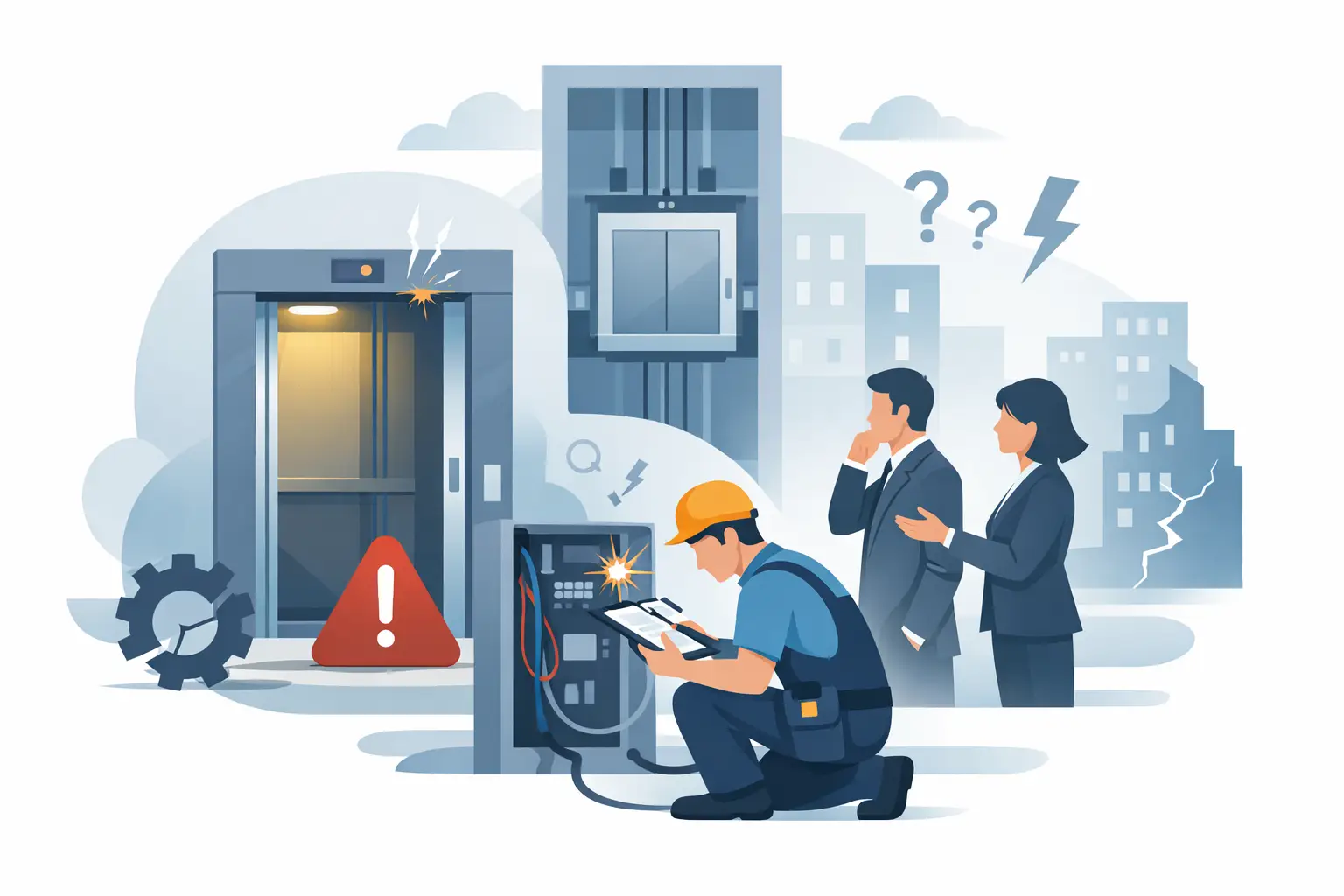
A lift that stops without warning rarely fails for just one reason. In most buildings, what causes lift faults is a mix of wear, environment, usage patterns, ageing components and delayed maintenance. For property owners and facility managers, the real issue is not only why a fault happened, but how quickly it can be identified, made safe and prevented from happening again.
Faults can range from a brief service interruption to a complete shutdown. Some are minor and easy to resolve. Others point to larger reliability or compliance issues that need urgent attention. The difference usually comes down to how the equipment has been maintained, how old the system is, and whether early warning signs were picked up before they turned into breakdowns.
What causes lift faults most often?
In practical terms, most lift faults come back to a few common causes. Components wear out over time, doors lose alignment, sensors become unreliable, electrical systems are affected by power quality, and control equipment can begin to fail as systems age. Heavy traffic, dust, moisture and harsh operating conditions also add pressure to equipment that may already be working hard every day.
That matters because lifts are not isolated machines. They are made up of mechanical, electrical and software-based systems all working together. When one part begins to perform poorly, it can affect the whole lift. A door operator that slows down, for example, may trigger repeated nuisance faults. A sensor that gives inconsistent readings may stop the lift as a safety precaution. In many cases, the system is doing exactly what it is meant to do – protecting passengers by taking the lift out of service when something is not right.
Wear and tear is still one of the biggest causes
Every lift has components that naturally degrade with use. Rollers, guide shoes, door tracks, locks, belts, relays and contactors are all subject to ongoing wear. In a low-use residential setting, that wear may develop slowly. In a hospital, shopping centre, school or commercial building, the same parts can deteriorate much faster.
This is one reason fault patterns vary from site to site. A lift in a high-rise office tower may experience door-related issues due to constant cycling. A goods lift may see more strain on mechanical parts because of heavier loads. A home lift may run less often, but still develop faults due to ageing electronics or batteries if service intervals are stretched too far.
Wear-related faults are not always dramatic. Often, they begin with small signs such as noisy operation, uneven levelling, slow door movement or intermittent shutdowns. Left alone, those early symptoms can lead to larger service disruptions.
Doors and door operators are frequent fault points
Lift doors are among the hardest-working parts of the system. They open and close constantly, rely on precise alignment, and must communicate properly with the control system before the lift can move. If a door is obstructed, misaligned or the operator is wearing out, the lift may refuse to run.
This is one of the most common examples of what causes lift faults in day-to-day operation. Dirt in the tracks, worn rollers, damaged locks and failing sensors can all stop doors from closing correctly. In public-facing buildings, accidental damage and misuse can also play a part.
Electrical and control system issues
Modern lifts depend heavily on electrical reliability. Power fluctuations, faulty wiring, deteriorated circuit boards and communication errors between components can all trigger faults. In some cases, the issue is internal to the lift. In others, the building power supply is the real source of the problem.
After a blackout, storm activity or voltage irregularity, lifts may require resetting or further diagnostics. Older controllers can be especially vulnerable if replacement parts are difficult to source or if the system no longer matches current building demands. When a controller starts failing, the symptoms can be inconsistent – random trips, call button issues, inaccurate floor stopping or repeated out-of-service events.
There is an important trade-off here. Repairs may keep an older controller running for a while, but repeated faults often point to a better long-term case for modernisation. For building owners, the right decision depends on downtime history, part availability, compliance requirements and budget.
Sensors, safety circuits and levelling problems
Lifts are designed to stop operation when safety conditions are not met. That is a feature, not a flaw. If a sensor detects an issue with door closure, car position, speed or load, the system may shut the lift down until the fault is cleared.
Levelling faults are a good example. When a lift does not stop flush with the floor landing, passengers can face a trip hazard. The cause may be worn brakes, encoder issues, sensor drift or control problems. In an aged care facility, residential development or healthcare site, even a small levelling error is not something to ignore.
Safety circuits can also be affected by loose connections, moisture ingress or failing components. These faults may appear intermittent at first, which can make them frustrating for building managers. Proper diagnosis matters. Resetting a lift without finding the source of the problem only delays the next shutdown.
Environment and building conditions matter more than many expect
Not all faults begin inside the lift itself. Machine rooms, shafts and landing areas can all affect system performance. Dust, heat, humidity, water ingress and poor ventilation can shorten the life of sensitive components. In coastal areas, corrosion may accelerate wear. In industrial settings, airborne particles and heavy-duty use create different maintenance demands again.
Building movement can also influence lift performance over time, particularly in taller buildings or sites with structural settlement. Even small alignment changes can affect doors, rails and ride quality. That is why lift servicing should always consider the operating environment, not only the equipment in isolation.
Usage patterns can expose hidden weaknesses
A lift may seem reliable during normal periods, then begin faulting when traffic increases. End-of-day peaks, school changeovers, hospital trolley movements or retail rush periods often reveal issues that are less obvious in quiet hours. High demand puts pressure on door systems, control logic and motor performance.
If faults occur mainly during busy times, the lift may be undersized for the building, overdue for adjustment, or showing early signs of component fatigue. This is where usage data and technician observations become valuable.
Poor or delayed maintenance increases fault risk
One of the clearest answers to what causes lift faults is missed maintenance. Lifts are safety-critical assets. They need scheduled inspection, testing, adjustment and replacement of worn parts before a breakdown occurs. When maintenance is reactive rather than planned, fault frequency usually rises.
This does not mean every fault is preventable. Some failures happen suddenly. But structured maintenance gives technicians the chance to spot trends, test safety functions, clean critical components and address minor wear before it leads to service disruption.
For property managers, the cost question often comes up here. It may seem cheaper to defer service or postpone repairs, especially if the lift is still running. In reality, that approach often results in more downtime, emergency callouts, tenant frustration and larger repair bills later.
Ageing lifts and obsolete parts
As lifts get older, faults often become harder to resolve quickly. Parts may be discontinued, technical support may be limited, and older systems may not meet the same performance expectations as newer installations. That does not automatically mean replacement is required, but it does change the repair equation.
When faults become frequent, a pattern usually emerges. Callouts increase, reset issues return, ride quality drops, and sourcing parts takes longer. At that point, modernisation can be the more practical option. Replacing key components such as controllers, door operators or signal systems can improve reliability without the cost of full replacement.
For owners managing long-term asset performance, this is often the turning point between repeated patch repairs and a planned upgrade.
When faults point to a bigger issue
Some faults are isolated. Others indicate a broader lifecycle problem. Repeated shutdowns, recurring door faults, ongoing levelling issues or frequent passenger entrapments should never be treated as business as usual. These patterns suggest the lift needs a more detailed technical review.
A capable service provider will look beyond the immediate symptom. That means checking fault logs, inspecting wear points, assessing part condition and reviewing whether the current system still suits the building. In many cases, the goal is not only to restore operation, but to reduce future disruption and protect the asset over time.
For building owners, developers and facility teams, reliability is not accidental. It comes from proper design, suitable equipment, responsive repairs and consistent maintenance carried out by qualified technicians. That is the standard Skyrise Elevators works to across installation, servicing, repairs and modernisation.
If your lift is showing small warning signs, it is worth acting before they become larger faults. A lift does not need to be completely out of service to be telling you something is wrong.