


Service Lift for Restaurants: What to Know
A busy kitchen can lose time in places most people never see. Staff waiting at a stairwell, plates cooling before they reach the dining room, rubbish moving through customer areas, and deliveries competing with front-of-house traffic all add friction. A well-planned service lift for restaurants helps remove that friction by moving food, stock, crockery and waste safely between levels without slowing the whole venue down.
For restaurant owners, builders and facility managers, that matters for more than convenience. Service flow affects customer experience, labour efficiency, hygiene and safety. In a multi-level venue, the right lift can support smoother operations every day. The wrong specification can create bottlenecks that are expensive to fix once the fit-out is complete.
Where a service lift for restaurants makes the biggest difference
Restaurants rarely have spare space or spare labour. When staff need to carry trays, ingredients or tubs up and down stairs, the cost shows up in slower service, higher risk of manual handling injuries and more pressure during peak periods. That pressure only increases in venues with split kitchens, basement storage, rooftop dining or function spaces on upper floors.
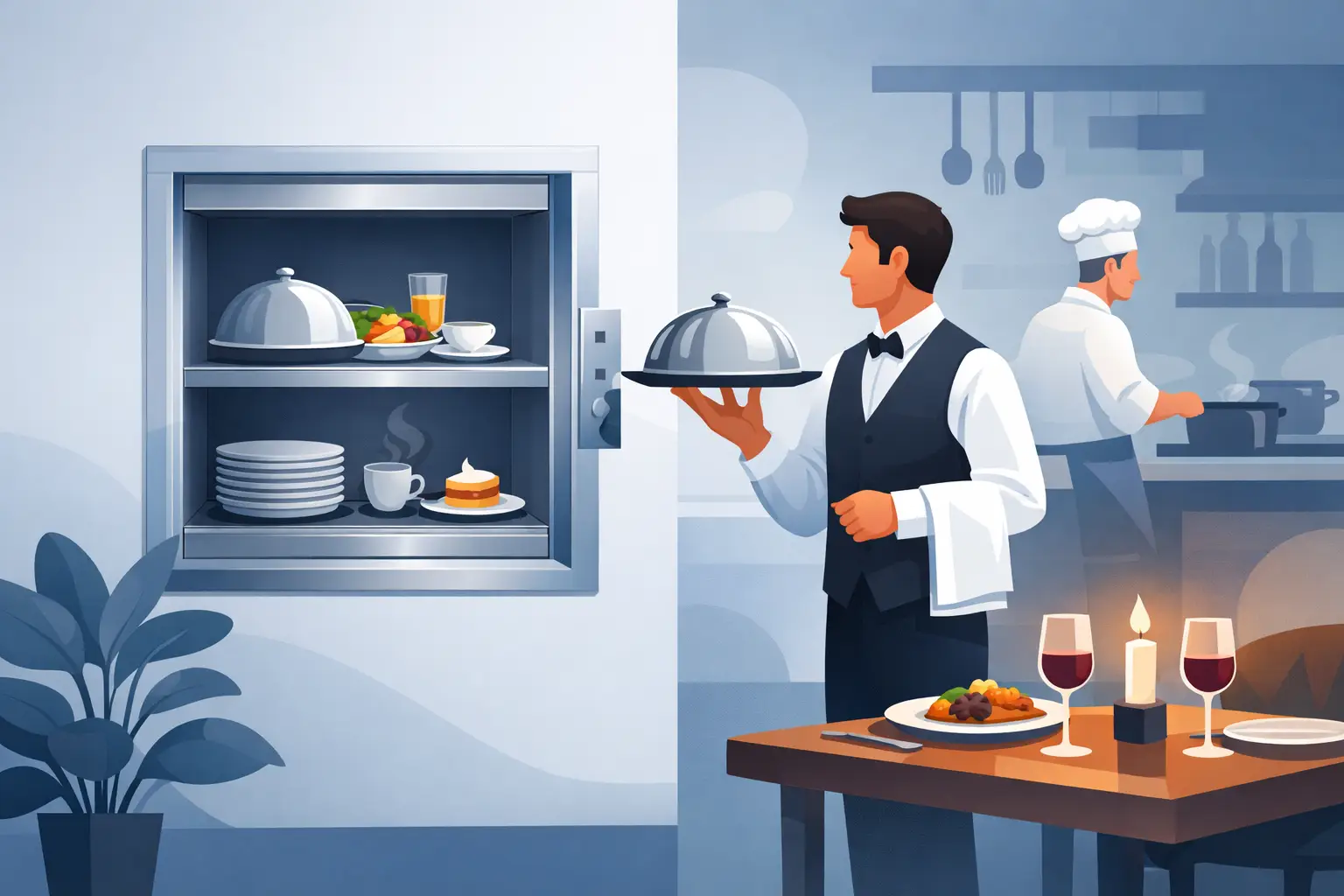
A service lift for restaurants is typically used to move goods rather than passengers. Depending on the layout, that might include plated meals from kitchen to dining level, dry stores from storage to prep areas, clean glassware to bars, or linen and waste away from customer-facing spaces. The practical value is simple – fewer unnecessary trips, less congestion and a more controlled back-of-house workflow.
This is particularly relevant in hospitality fit-outs where every square metre has to work hard. If your team is moving stock by hand because there is no dedicated vertical transport, the building is asking people to solve an infrastructure problem every shift.
Choosing the right lift starts with the building layout
No two restaurants operate the same way, so lift selection should start with how the venue actually functions. A small cafe with basement storage has very different needs from a hotel restaurant serving multiple levels or a large licensed venue with separate bar and dining floors.
The first question is what the lift needs to carry. That sounds obvious, but it is often underestimated. A service lift may need to handle meal trolleys, beverage cartons, bulk ingredients, cleaning supplies or bins. Capacity should be based on realistic operating loads, not best-case assumptions. Under-specifying can shorten equipment life and frustrate staff from day one.
Travel distance and stop locations also matter. If loading points are awkward, cramped or poorly aligned with kitchen benches and service corridors, the lift can become another obstacle instead of a solution. Door configuration, car size and landing access should support the way staff move during a live service, not just look acceptable on a drawing.
Ceiling height, shaft space and structural constraints can all influence what is possible. In existing buildings, retrofit conditions may limit options, which is why early technical input is valuable. It is usually easier and more cost-effective to solve these issues before construction or refurbishment is locked in.
Capacity, size and use case
A restaurant service lift should match both current and expected demand. If a venue plans to expand trading hours, increase seating or add function operations, the lift should be assessed against those future requirements as well. Installing a unit that only suits the opening phase can create a costly upgrade problem later.
There is also a difference between moving small items frequently and moving larger loads less often. Some venues benefit from compact dumbwaiter-style solutions for food and light goods. Others need a larger goods or service lift capable of handling heavier loads, trolley traffic or more demanding back-of-house use. The right answer depends on operation, not just footprint.
Hygiene and separation are not optional
In hospitality, movement pathways matter. Food, clean items, dirty items and waste should not all follow the same route if it can be avoided. A service lift can support better hygiene control by separating these flows and reducing crossover between front-of-house and utility areas.
Material finishes are part of that equation. Internal lift surfaces should be durable, easy to clean and suited to a commercial environment. Stainless steel is often preferred because it stands up well to frequent cleaning and heavy use. Controls, doors and thresholds should also be considered from a cleaning and durability perspective, not just appearance.
The venue’s operating model will shape what level of separation is required. A fine dining restaurant may prioritise discreet food transfer and presentation. A high-volume venue may focus more on stock movement and waste handling. In either case, the lift should support compliance and practical hygiene management rather than complicate it.
Safety and compliance in a working restaurant
Restaurant environments are fast, hot and often crowded. Any equipment installed in that setting needs to be dependable and suited to commercial use. Safety is not just about meeting standards on paper. It is about reducing risk during the busiest part of the day when staff are under pressure.
A properly specified service lift for restaurants can reduce manual carrying on stairs, lower trip risks and support safer movement of heavy or awkward loads. That said, the lift must be appropriate for the intended use. Misuse often starts when equipment is undersized, poorly located or difficult to operate.
Compliance requirements vary depending on the lift type, building class and application. Fire considerations, access conditions, load ratings, landing protections and control systems all need proper assessment. This is where working with an experienced provider is important. Restaurant owners and builders do not need vague advice – they need a lift solution that fits the site, meets requirements and performs consistently.
New installation or retrofit
In a new build, there is more freedom to plan shaft location, service routes and loading zones around the lift. That generally leads to a better operational result. In an existing venue, retrofit work can still deliver strong value, but planning has to be tighter. Structural limitations, service penetrations and trading continuity can all affect installation sequencing.
For operators refurbishing a live venue, downtime is a major concern. A capable lift partner should be able to identify practical installation pathways, coordinate around site conditions and minimise disruption where possible. That service matters just as much as the hardware.
Maintenance is what protects uptime
A service lift is only useful when it is available. In restaurants, downtime can force staff back onto stairs immediately, often during service. That means maintenance should be treated as part of the operating model, not an afterthought once the installation is finished.
Regular servicing helps identify wear before it turns into a breakdown. Doors, controls, drive components and safety systems all need inspection and adjustment over time. In hospitality environments, heavy daily use and exposure to grease, moisture and frequent cleaning can accelerate wear if maintenance is neglected.
Responsive repair support also matters. When a lift stops in a restaurant, the impact is immediate. Stock movement slows, food service can be disrupted and staff are forced into workarounds that are less safe and less efficient. A structured maintenance program backed by approved technicians helps reduce those risks and extend the life of the equipment.
For many venues, the long-term value of the lift depends less on the initial install cost and more on how reliably it performs across years of service. That is why service support should be considered early, alongside design and specification.
What restaurant decision-makers should ask before proceeding
Before committing to a lift, it is worth stepping back and looking at the full operating picture. What exactly needs to move between levels, how often, and at what times of day? Will the lift be used for food, stock, crockery, waste or all of the above? Is the proposed location convenient for staff, or simply the only spot left in the plan?
It is also worth asking how the lift will be maintained, how repairs will be handled and whether the system can be modernised down the track if the venue changes. A low upfront price can become expensive if the unit is hard to service, poorly suited to the site or prone to downtime.
For property owners and developers, there is a broader asset question as well. A restaurant-ready service lift can improve leasing appeal and building functionality, especially in mixed-use or hospitality-led developments. It supports operations from day one and can make a tenancy more workable for future occupants.
At Skyrise Elevators, this is where practical planning matters most. The best service lift is not the one with the most features. It is the one that fits the building, supports the kitchen, handles the real workload and keeps operating when the venue is at full pace.
If your restaurant relies on movement between levels, the lift should do more than fill a gap in the plans. It should remove strain from staff, protect service standards and make the building easier to run every day.