


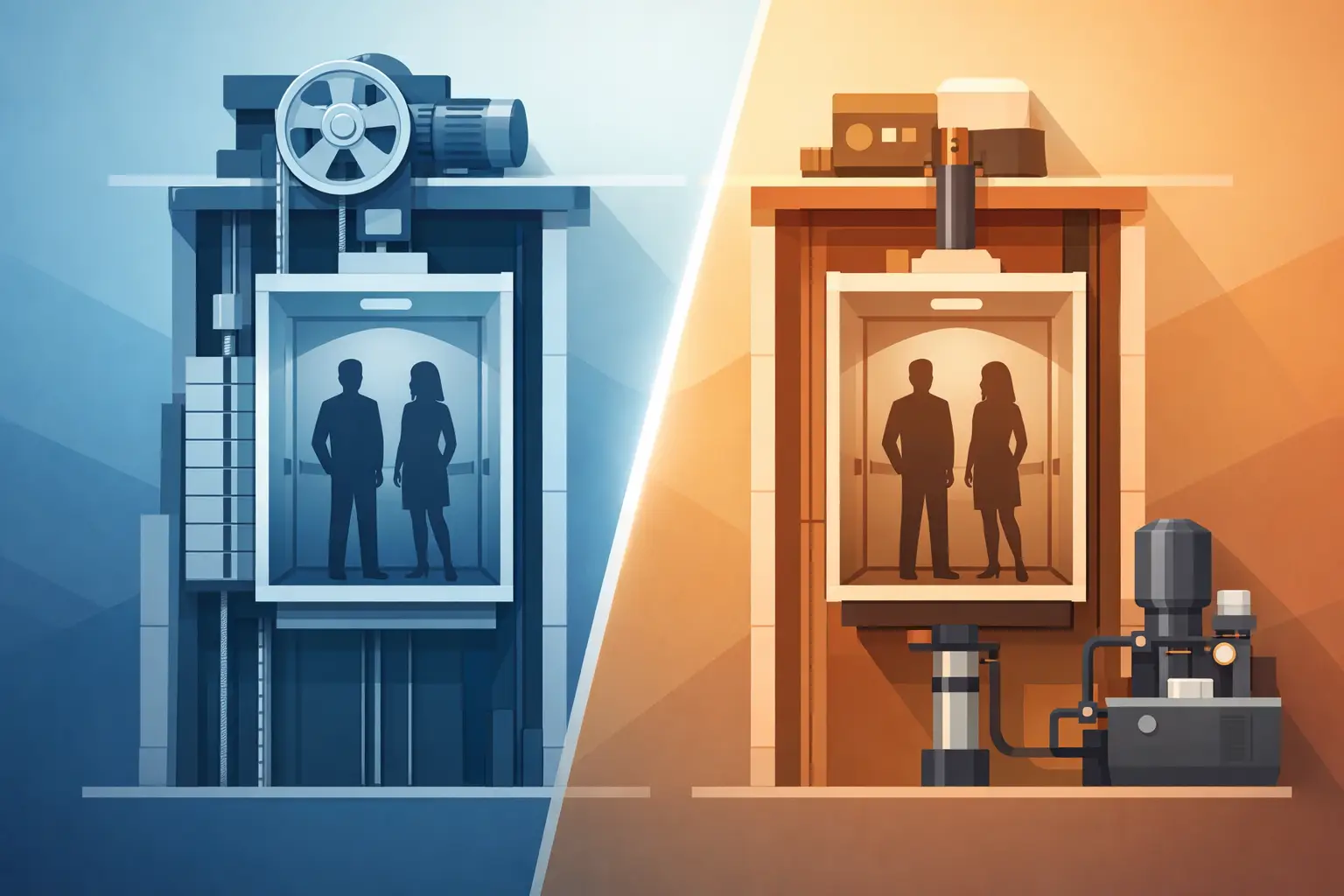
Traction Versus Hydraulic Lifts Compared
A lift choice made during design can affect a building for decades. When comparing traction versus hydraulic lifts, the right answer depends less on which system is ‘best’ and more on the building’s height, available space, passenger or goods demand, budget and long-term operating priorities.
For a low-rise home, retail site or industrial application, a hydraulic lift may be a practical fit. For a multi-level commercial building with frequent use, a traction system will often provide better travel speed and energy performance. Both can deliver safe, dependable vertical transport when they are correctly specified, installed and maintained.
How traction and hydraulic lifts work
A traction lift moves the car using steel ropes or coated belts running over a drive sheave. The motor turns the sheave while a counterweight offsets much of the car’s weight and part of its rated load. This reduces the energy needed to move the lift, particularly in taller buildings or sites with regular traffic.
Most modern traction lifts use a compact gearless machine, often located in the lift shaft rather than a separate machine room. This configuration can suit projects where plant-room space is limited, although the shaft, pit and overhead requirements must always be confirmed early in the design process.
A hydraulic lift is raised by a piston powered by hydraulic fluid. A pump unit sends fluid into the cylinder to lift the car, then a control valve regulates the descent. Because the system does not rely on a counterweight, hydraulic technology can be well suited to certain low-rise applications and heavy-duty lifting requirements.
The power unit is usually located in a nearby cabinet or machine room. Layout options vary, so it is still necessary to allow for access, ventilation, service clearances and the requirements of the selected equipment.
Traction versus hydraulic lifts by building type
Height is one of the clearest decision points. Traction lifts are generally preferred for medium and taller buildings because they can travel further and operate at higher speeds. In an apartment building, office, hotel, healthcare facility or mixed-use development, that means shorter waiting and travel times for occupants.
Hydraulic lifts are commonly considered for low-rise buildings, often where travel is limited to a few floors. They can be an effective solution for homes, small commercial premises, schools, warehouses and service applications where speed is not the primary concern.
That does not make the choice automatic. A low-rise medical centre with constant passenger traffic may benefit from traction performance. Conversely, an industrial facility may require a hydraulic goods lift because load capacity, car configuration and operating conditions matter more than travel speed. The intended use of the lift should lead the conversation.
Passenger lifts, home lifts and goods applications
For passenger lifts, traction systems are often selected where a smooth ride, higher speed and frequent service are expected. They are a common choice for commercial developments and larger residential buildings where tenants rely on the lift throughout the day.
For a home lift, either option may be appropriate depending on travel distance, architectural constraints and the homeowner’s accessibility needs. The final design should consider door positions, car size, power supply, shaft construction and future maintenance access, not only the drive type.
For goods and service lifts, hydraulic systems can be particularly useful where substantial loads must be moved over short distances. However, a traction goods lift may be the stronger option where the building is taller, use is intensive or faster movement between levels supports operations.
Space, shaft design and installation planning
The available building space can influence the choice as much as travel height. Traction lifts usually need sufficient overhead clearance for the equipment and required safety spaces at the top of the shaft. Machine-room-less designs can reduce the need for a separate plant room, but they do not remove the need for careful shaft coordination.
Hydraulic lifts may have different overhead requirements and can be advantageous on sites where top-of-shaft space is constrained. They may, however, require space for a hydraulic power unit and associated controls. Depending on the system, the project may also need to accommodate a cylinder below or beside the lift shaft.
Pit depth, structural loads, fire rating, electrical supply, waterproofing and safe technician access all require early attention. Retrofitting a lift into an existing building adds another layer of complexity. A detailed site assessment helps identify whether one system will avoid costly structural alterations or protect usable floor area.
Energy use and operating costs
A traction lift’s counterweight means the motor does not need to lift the full car load on every upward trip. This can make traction technology more energy-efficient for buildings with frequent use or greater travel distances. Some configurations can also return energy during certain operating conditions, depending on the drive and building electrical setup.
Hydraulic lifts draw significant power while travelling up because the pump lifts the car directly. During descent, the car is lowered through controlled fluid release rather than being powered down in the same way as a traction lift. For a lightly used, low-rise lift, the total energy difference may be modest. For a busy building, it can become a meaningful lifecycle consideration.
Initial cost should be assessed alongside electricity use, maintenance, expected service life and likely modernisation requirements. The least expensive installation option is not always the lowest-cost choice over 15 or 20 years of operation. A reliable system that suits the building’s demand can reduce disruption, complaints and avoidable call-outs.
Ride quality, speed and user experience
Traction lifts generally offer higher travel speeds and are well suited to applications where users expect prompt service. Modern traction systems can also provide a refined ride quality, accurate floor levelling and responsive door operation when correctly maintained.
Hydraulic lifts usually travel more slowly. This is rarely a problem in a private residence or a building with only a small number of stops, but it can be noticeable during peak periods in commercial settings. Ride quality is influenced by installation quality, control settings, loading and maintenance, so no system should be judged on drive type alone.
For facility managers, user experience includes more than the ride itself. It includes reliability, levelling accuracy, door performance, communication systems and how quickly a fault can be diagnosed and resolved. Choosing established equipment with accessible service support is essential.
Maintenance and environmental considerations
Both lift types require planned maintenance by approved technicians. Regular servicing identifies wear before it leads to shutdowns and helps maintain safe operation, particularly for doors, brakes, safety devices, controls and emergency communication equipment.
Traction systems require inspection of components such as ropes or belts, sheaves, brakes and drive equipment. Hydraulic systems need attention to fluid condition, hoses, seals, valves, the pump unit and cylinder performance. The service tasks differ, but the goal is the same: minimise downtime and keep the lift operating safely.
Hydraulic systems also require responsible management of hydraulic fluid. Equipment condition, containment and prompt attention to leaks are important for both environmental protection and building maintenance. Modern products and proper installation can manage these risks, but they should be considered as part of the whole-of-life plan.
Choosing the right lift for your project
The most suitable lift is the one that matches the building, not a generic preference for traction or hydraulic technology. Start with the number of floors, travel height, rated load, anticipated trips, passenger expectations and the space available for the shaft and equipment. Then consider future use: a building that may change tenants or operating patterns could need greater capacity than it requires on day one.
For many medium and high-rise passenger applications, traction lifts offer the speed and efficiency needed for dependable daily service. For lower-rise, heavy-load or space-specific projects, hydraulic lifts can be a sensible and effective solution. A site-specific assessment will clarify the structural, electrical, compliance and maintenance implications before work begins.
Skyrise Elevators can assess new installations, replacements and modernisation projects with the full operational picture in mind. The best lift decision is one that gives building users safe, convenient access today while remaining practical to service and operate well into the future.