


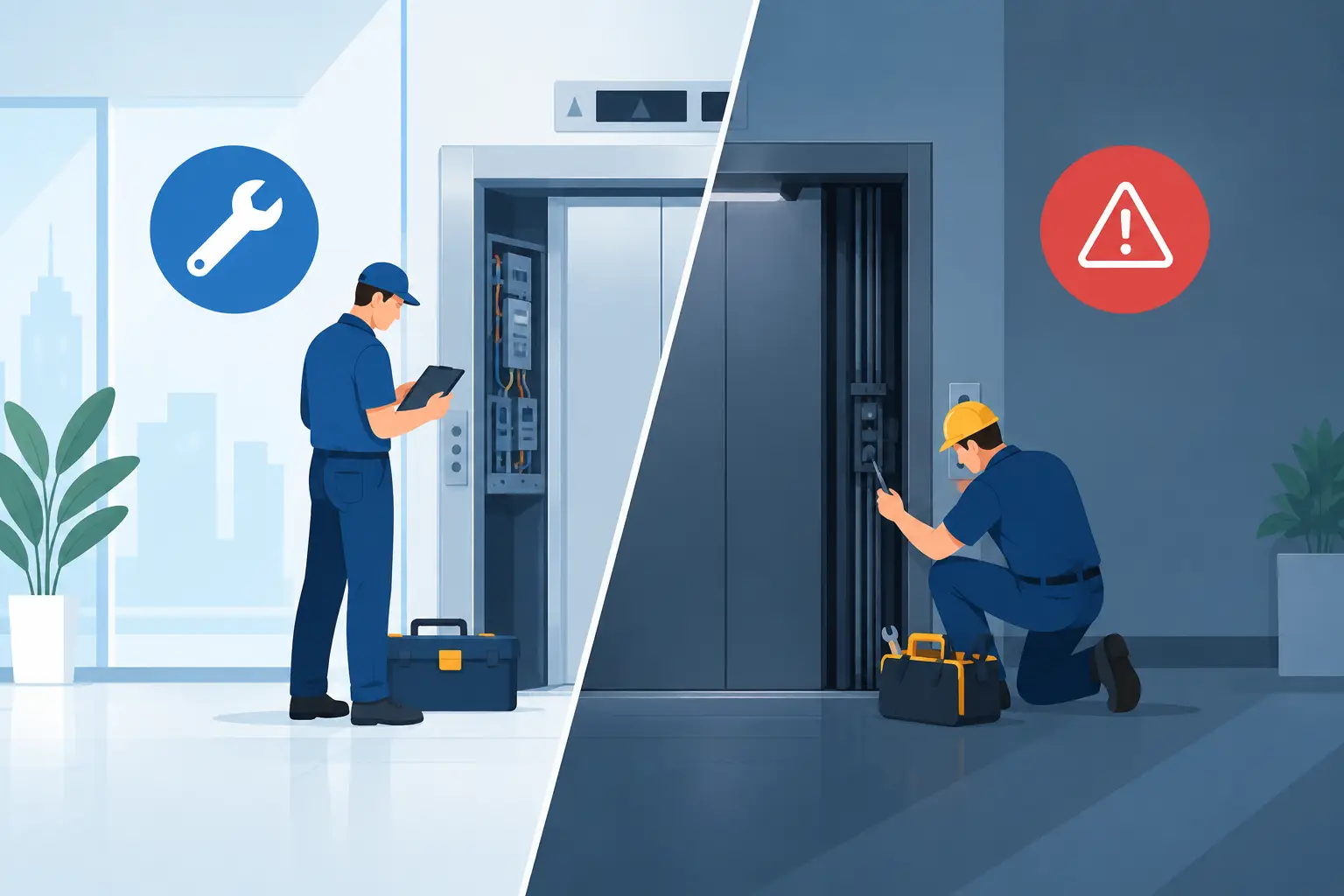
Lift Maintenance Versus Breakdown Repairs Compared
A lift stopping between floors at the start of a busy workday creates more than an inconvenience. It can affect accessibility, tenant confidence, deliveries, staff movement and building operations within minutes. The difference between lift maintenance versus breakdown repairs is often the difference between planned, controlled service work and an urgent disruption that places pressure on everyone involved.
For property owners and facility managers, the question is not whether a lift will ever need attention. All mechanical and electrical equipment experiences wear over time. The practical decision is how to manage that wear, minimise downtime and make sound decisions about repair, modernisation or replacement.
Lift maintenance versus breakdown repairs: what changes
Lift maintenance is planned work completed at regular intervals to keep equipment operating safely and efficiently. A technician inspects key components, tests operation, identifies wear, makes adjustments and addresses minor issues before they become larger faults. The exact scope depends on the lift type, age, use, building environment and maintenance agreement.
Breakdown repairs are reactive. They take place after a fault has already affected the lift’s operation, whether that means a door will not close, the car has stopped, a fault code is present, levelling is inconsistent or a passenger has been trapped. The immediate priority is to restore safe service, but the repair may also require fault finding, parts sourcing and follow-up work.
A breakdown can occur even with a well-managed maintenance programme. Sudden electrical faults, power events, vandalism, water ingress and component failure are not always predictable. However, regular servicing gives technicians more opportunities to detect deteriorating door gear, worn rollers, unusual noises, control system irregularities or components approaching the end of their service life.
The distinction matters because planned maintenance allows a building team to schedule access, notify occupants and approve routine work with far less disruption. Reactive repairs happen on the lift’s timetable, not yours.
The real cost is often downtime
It is tempting to compare a maintenance invoice with the cost of a single repair call-out and assume reactive servicing is more economical. That comparison rarely captures the full picture. A breakdown may involve attendance outside normal hours, diagnostic time, replacement components and repeat visits where specialist parts are required.
There are also operational costs that do not always appear on the repair invoice. A non-operational lift can make upper levels difficult to access, disrupt goods movements, create delays for visitors and affect people who rely on accessible vertical transport. In healthcare, aged care, education, retail and industrial settings, the impact can be particularly significant.
For residential buildings, a lift outage can quickly become a daily concern for residents with mobility needs, prams, groceries or large items. In commercial properties, repeated failures can affect tenant satisfaction and the perceived quality of the building. Preventive maintenance cannot remove every risk, but it reduces the likelihood that a small, manageable issue develops into an unplanned outage.
What a structured maintenance programme should achieve
Effective lift maintenance is not simply a technician arriving at a fixed interval and completing a checklist. It should be based on the equipment installed, how heavily it is used and the conditions it operates in. A lift in a low-rise residential property has different demands from a high-traffic office, hospital, warehouse or mixed-use development.
A structured programme supports early fault detection and gives building managers clearer visibility of the lift’s condition. During visits, technicians can inspect items such as door operation, landing equipment, car levelling, safety circuits, drive systems, controller performance and emergency communication equipment. They can also identify concerns that may not yet be obvious to passengers.
The value lies in the recommendations that follow. If a component is showing progressive wear, planned replacement can often be arranged during a suitable service window. This gives the owner time to consider costs and avoids the pressure of making a decision while the lift is out of service.
Maintenance records also help establish patterns. If the same fault returns, or if repairs are becoming more frequent, that information supports a better lifecycle decision. It may point to a targeted upgrade, a modernisation project or, in some cases, a replacement strategy rather than continuing to spend on short-term fixes.
Maintenance frequency should reflect building use
There is no one maintenance schedule that suits every lift. High-use equipment, lifts exposed to dust or moisture, goods lifts and systems serving critical environments may need more attention than lightly used residential equipment. Older lifts can also benefit from closer monitoring where original components are becoming harder to source.
The right approach is practical rather than excessive. Maintenance should focus on keeping the lift dependable, safe and suitable for its intended use, without recommending unnecessary work. A capable service provider will explain what has been found, why it matters and what could happen if the issue is deferred.
When a repair is enough and when it is not
Many lift faults can be resolved with a straightforward repair. A worn door component, damaged sensor, failed button, minor adjustment or isolated electrical issue does not automatically mean the lift needs major works. Timely repairs are an essential part of responsible lift ownership.
The decision changes when faults become recurring, downtime increases or the equipment no longer meets the building’s operational needs. An older controller may be serviceable but dependent on obsolete parts. Door systems may require repeated attention. The lift may also feel slow, unreliable or poorly suited to the number of people using it each day.
At that point, continuing with individual breakdown repairs can become a false economy. Modernisation may improve reliability by replacing selected ageing systems while retaining suitable existing lift infrastructure. Depending on the building and equipment condition, this could involve controls, door operators, fixtures, drive systems or safety-related components.
Full replacement is generally a larger decision, but it can be appropriate where the lift has reached the end of its practical life, major components are no longer viable, or the property requires a different capacity, configuration or level of performance. The best option depends on technical condition, availability of parts, building use, budget and the acceptable level of future risk.
How building managers can reduce repair risk
The simplest starting point is to treat unusual lift behaviour as an early warning, not something to tolerate until the next outage. Slower door movement, repeated re-opening, uneven levelling, intermittent faults, unusual sounds or regular passenger complaints should be reported promptly.
Building teams can also help by keeping lift landings clear, monitoring water ingress near entrances and plant areas, and ensuring contractors do not damage doors or finishes while moving bulky materials. For goods and service lifts, operating within the rated capacity and using the lift as intended helps protect equipment from avoidable strain.
Clear communication is equally valuable. Occupants should know how to report faults and what to do if they become trapped. Facility managers should retain service records and review recurring recommendations rather than approving work in isolation. This creates a more complete picture of lift performance over time.
Choosing a service partner for the full lifecycle
A lift provider should be able to respond when a fault occurs, but response alone is not the full measure of service quality. The stronger relationship is one where technicians understand the equipment, communicate clearly and help the owner plan ahead.
Look for a provider that can support routine maintenance, breakdown repairs, fault diagnosis, modernisation and replacement. This breadth matters because lift issues do not always have a one-size-fits-all solution. A provider with lifecycle capability can recommend the most suitable action for the building rather than treating every problem as another call-out.
Skyrise Elevators supports property owners and managers with practical lift servicing, responsive repairs and long-term solutions for residential, commercial and industrial environments. The aim is to keep vertical transport operating reliably while giving decision-makers clear information when equipment needs attention.
A lift does not need to fail completely before it deserves a closer look. Regular maintenance, prompt reporting of early faults and well-timed improvement works give your building the best chance of avoiding disruptive repairs when accessibility and uptime matter most.