


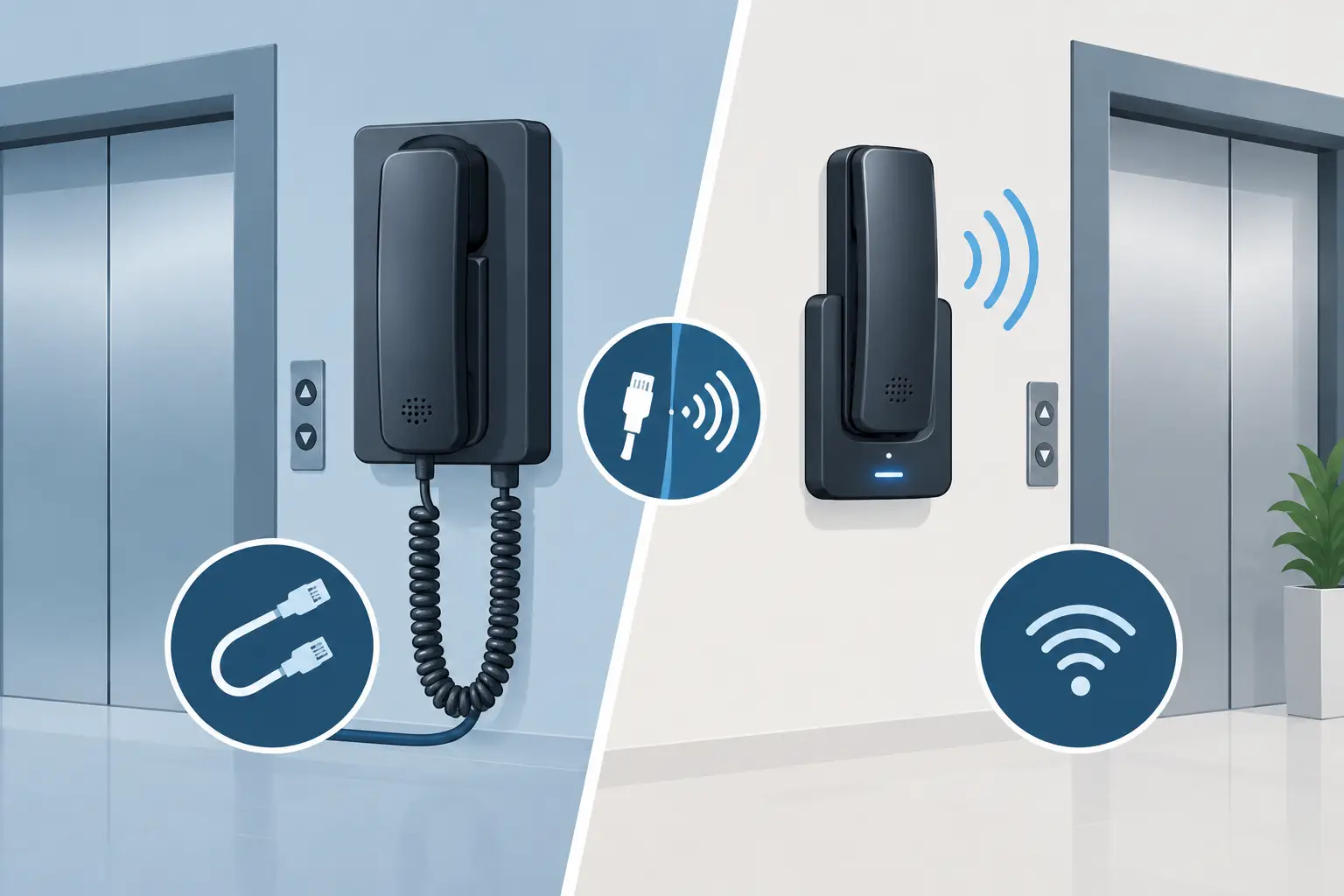
Wired Versus Wireless Lift Phones Compared
A lift phone is not an optional convenience when a passenger is trapped. It is a critical part of the lift’s emergency communication arrangement, and it must work when it is needed most. The decision between wired versus wireless lift phones affects installation cost, ongoing reliability, fault finding and how well the system suits your building.
For a new development, a wired connection may be straightforward to incorporate during construction. In an older building, running new communication cabling to the lift motor room or shaft can be disruptive and costly. Wireless lift phones can provide a practical alternative, but only where mobile coverage, power backup and equipment selection have been properly assessed.
The right answer depends on the lift, the building and the level of assurance required. A dependable system begins with a site-specific review rather than choosing a phone type on price alone.
What a lift phone needs to do
A lift emergency phone gives passengers a direct means of calling for assistance from inside the lift car. When the alarm button is pressed, the system should connect to a monitored contact point, building representative or emergency response arrangement that can identify the lift location and organise help.
The phone must remain reliable through normal operation and foreseeable fault conditions. That means considering the communication path, power supply, battery backup, signal strength, line supervision and ongoing testing. A handset that looks suitable in the car but cannot make a call during a power outage or network fault does not provide the protection building occupants expect.
For facilities managers, the aim is clear: a system that supports safe passenger recovery, reduces uncertainty during an entrapment and can be maintained without avoidable downtime.
Wired versus wireless lift phones: the key difference
A wired lift phone uses a physical telecommunications connection between the lift equipment and the outside communication network. Depending on the installation, this may involve dedicated cabling, a fixed-line service or an appropriately configured voice service connected through the building’s communications infrastructure.
A wireless lift phone uses a mobile network connection, generally through a SIM-enabled communicator installed with the lift control equipment. When activated, it places a call over the available mobile network rather than relying on a fixed telephone line.
Neither option is automatically better. Wired systems can offer a stable, predictable connection where cabling and fixed services are available. Wireless systems can avoid extensive cable works and help buildings transition away from ageing telephone infrastructure. The practical question is which system can provide dependable communication in that particular lift installation.
When a wired lift phone is the better fit
Wired lift phones are often well suited to new commercial buildings, hospitals, education sites and larger facilities where communications cabling can be planned alongside the lift installation. If the cable pathway is accessible and the building already has suitable communications services, a wired solution can be a sensible long-term choice.
The main advantage is connection consistency. A physical connection is not dependent on mobile signal levels within a basement, concrete lift shaft or plant room. This can be particularly valuable in buildings with poor internal mobile reception or in locations where signal conditions change between carriers.
Wired systems also make sense when a property owner wants the emergency phone to sit within an established building communications strategy. However, the fixed service itself should be assessed carefully. Older analogue services are being withdrawn or replaced across Australia, and some modern voice services may rely on building power or network equipment. The lift phone arrangement must be designed around those dependencies, not simply connected to the nearest available line.
The trade-off is installation complexity. Retrofitting cabling through existing shafts, risers or finished areas can require additional access work. In older strata buildings, this may affect cost, scheduling and resident disruption.
Where wireless lift phones make practical sense
Wireless lift phones are commonly considered during lift modernisation, replacement projects and retrofits where installing new telecommunications cabling would be difficult. A mobile communicator can be installed near the lift controller, avoiding the need to run a dedicated fixed telephone connection from the building boundary to the lift equipment.
This approach can reduce installation disruption and remove reliance on legacy copper services. It may also be useful for smaller residential buildings, remote sites, industrial premises and temporary works where a conventional fixed line is not practical.
Wireless does, however, depend on a proven signal. Lift shafts are often surrounded by reinforced concrete, metal and multiple floors of building structure. A mobile phone may work perfectly in the foyer while the communicator has an unreliable signal in the motor room, shaft or controller cabinet. A proper signal test at the equipment location is essential.
The system also needs suitable power resilience. The communicator, its network equipment and any required battery backup must be considered as one emergency communication system. If mains power is lost, the arrangement should continue to operate for the required period and report faults where applicable.
Australia’s 3G network shutdown is another reason to check existing wireless lift phones. Older devices that depend on 3G may no longer operate reliably, even if they appeared to be working previously. A current 4G or 5G-capable solution, selected for the available network and supported over its expected service life, is the safer approach.
Reliability is about the whole system
It is easy to compare wired and wireless lift phones as though the cable or SIM card is the only variable. In practice, reliability comes from the complete installation.
For wired phones, this includes the condition of the cabling, the type of fixed service, the location of network equipment and whether that equipment remains powered during an outage. For wireless phones, it includes signal quality, carrier coverage, antenna placement, SIM management, battery condition and device compatibility.
A lift phone should also be configured so responders know which lift has made the call. In a multi-lift commercial building, vague call identification can delay the response when every minute matters. Clear site details, lift identification and current emergency contacts should be maintained as part of the building’s lift records.
Regular testing is equally important. A test confirms more than dial tone. It verifies call connection, voice clarity, caller identification, response procedures and the condition of backup power. Maintenance visits provide a practical opportunity to inspect the communicator and identify issues before a passenger needs it.
Cost, maintenance and future planning
Upfront cost can favour wireless where cabling is difficult, while a wired system may be cost-effective when installed during construction. The longer view is more important than the initial installation figure.
Wireless systems generally involve an ongoing mobile service plan and periodic review of carrier technology. Wired systems may have fixed service charges, network equipment costs or future changes as building telecommunications infrastructure evolves. Both options require routine lift maintenance and prompt attention to communication faults.
For building owners and managers, consider whether the selected system can be supported over the life of the lift. Ask how faults are reported, who manages the service account, what happens if the mobile carrier changes technology, and whether a replacement can be installed without major works. These details are particularly relevant for strata properties, aged care sites and facilities with limited onsite technical staff.
Choosing the right lift phone for your building
A wired lift phone is often the stronger option where stable fixed infrastructure is available and can be supported through power interruptions. A wireless lift phone can be the more efficient choice where cable installation is impractical, provided signal testing confirms dependable coverage and the unit has appropriate backup arrangements.
For many properties, the decision is made during a lift upgrade or communications review. This is the right time to inspect the existing emergency phone, confirm whether it relies on outdated network technology and assess the needs of the people using the building. A residential lift serving a few levels has different operational demands from a busy hospital, retail centre or industrial goods lift.
Skyrise Elevators can assess the lift equipment, building conditions and communication requirements before recommending a suitable solution. The most valuable outcome is not simply a wired or wireless device in the cabinet – it is the confidence that a passenger can call for help and the right people can respond when it matters.